Hare-brained History Vol. 121: The Manson Family
One I am very proud of

Welcome to the 121st installment of Hare-brained History, a blog in which your intrepid host treats you to absurdities, follies, mind-fucks, and everything in between from the world of history. Today, there’s really no point in beating around the bush. Join me as we head to California to examine one of the most infamous cults and crimes in American history: the Manson Family.
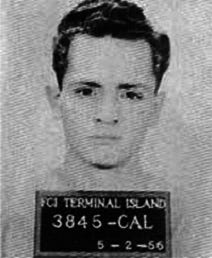
Manson was born on November 12, 1934, to sixteen-year-old Ada Kathleen Maddox in Cincinnati, Ohio. That was literally the name on his birth certificate. Maddox later filed a paternity suit against a man named Colonel Walker Henderson Scott. Ada believed “Colonel” was his military rank, but it was actually just his first name, a misunderstanding Scott exploited. When she told him she was pregnant, he claimed he had army business to attend to and disappeared. In 1937, the paternity suit was resolved through an agreed judgment, awarding Maddox a few dollars without Scott ever being legally recognized as the father.
Regardless, the child known as Manson, Charles Milles Maddox, never knew his father. Instead, his pregnant mother had married 25-year-old William Eugene Manson a few months before his birth. The teenager was, well, not a great mother. She went off on drinking and criminal sprees with her older brother, leaving Charles alone or with babysitters. William Manson put up with Ada for two years before divorcing her for “gross neglect of duty” in 1937, leaving Charles’ life forever. (Charlie Manson would be Charles Maddox legally and by others until 1967, but for my own sake, we are just going with Charles Manson).
On August 1, 1939, Ada and her brother were arrested for assault and robbery. Charles was sent to live with an aunt and uncle in West Virginia. His mother was paroled for good behavior in 1942, and he later characterized this as the happiest time of his life, playing hooky from school to spend time with his mother, who spent much of hers drinking. She was soon arrested for grand larceny but could not be convicted, and before long they fled the state for Indianapolis, where his mother met a man at an AA meeting and married him in 1943.
Suffice it to say, Charles Manson did not have a good childhood, and it would only get worse. In a much later interview, he claimed he had set his school on fire when he was nine. Whether or not that was true, he was frequently in trouble, both at school and with the police, for skipping class and petty theft. As a result, he was sent to the Gibault School for Boys in Terre Haute, Indiana, a reform school run by Catholic priests. In very Catholic fashion, minor rule infractions were met with beatings from a wooden paddle or a leather strap.
Before long, Manson ran away, sleeping in woods, sheds, and under bridges before returning to his mother. She took him for Christmas to his aunt and uncle’s house in West Virginia before sending him back to Gibault. He lasted another ten months before running away again, committing his first documented crime in Indianapolis when he robbed a grocery store to find something to eat.
The child, he was fourteen, attempted to make an honest living and took a job as a messenger for Western Union, but that was always going to be short-lived, and he was arrested for theft in 1949. The judge, as sympathetic as a judge could be in 1949, sent him to a juvenile facility in Omaha, Nebraska. After just four days, he and a fellow student escaped, stole a gun and a car, and drove to Illinois, committing armed robberies along the way. The other boy’s uncle was a professional thief, and he took them on as apprentices. Just two weeks later, however, Manson was caught during the robbery of a store in Peoria, Illinois and this time sent to a stricter reform school outside Plainfield, Indiana.
According to Manson, while there, other students sexually assaulted him, apparently with the encouragement of a staff member. While everything Charles Manson said should be taken with a huge grain of salt, sexual assault was, and remains, a very real and all-too-common crime in American prisons and juvenile justice facilities and, as we saw with Clyde Barrow, can send an already damaged young person even further down a dark path. Manson ran away from the school eighteen times and, to defend himself, developed a technique he called the “insane game,” pretending to be crazy to scare off would-be assailants. In February 1951, he escaped for good and spent the next several months robbing gas stations and stealing cars until he was arrested in Utah.
Driving stolen cars across state lines was a federal crime, and Manson was sent to Washington, D.C.’s National Training School for Boys. Upon arrival, he underwent aptitude and psychological testing, which found him to be aggressively antisocial, that is, he didn’t give a fuck about anyone. He was also illiterate but possessed a slightly above-average IQ.
On a psychiatrist’s recommendation, the sixteen-year-old Manson was transferred to a minimum-security institution in Virginia. His aunt from West Virginia visited and told administrators she would look after him and help him find work, and it appeared he would be released at his parole hearing scheduled for February 1952. Instead, in January he was caught raping a boy at knifepoint and transferred to the Federal Reformatory in Petersburg, where he committed a further “eight serious disciplinary offenses, three involving homosexual acts.” Now somehow, perhaps simply because they wanted to rid themselves of him, he was released early for good behavior in May 1954.
In January 1955, he married a 15-year-old waitress and moved to Los Angeles, where, that October, he was arrested for driving a stolen car and once again charged with a federal crime. After a psych eval, for likely more reasons of “we just don’t want to deal with him,” he was given probation. However, his failure to appear at a hearing led to his arrest and a three-year sentence at Terminal Island in Los Angeles.
While in prison, his wife gave birth to his son, Charles Manson Jr., and spare a thought for him. His wife and son left him for good before he got out. After being released, he was arrested trying to steal another car and was sent back to prison. Somehow released again, while his wife was filing for divorce, he was out pimping a 16-year-old girl while also carrying on a relationship with another young woman from a rich family who was financially supporting him.
In September 1959, he plead guilty to attempting to cash a forged Treasury check, but another young woman, “Candy” Stevens, appeared at sentencing and made a moving, tearful plea to keep Manson out of prison, saying the couple were deeply in love and that they “would marry if Charlie were freed.” Both the freedom and the marriage followed, and the pair, along with another woman, went to New Mexico, where the scraggly-looking throuple drew attention. Charlie was detained and questioned for violating the Mann Act, transporting prostitutes across state lines.
Charlie was released, but he correctly realized he was still under investigation and decided to make a break for it, prompting the issuance of a bench warrant. He was arrested in Laredo, Texas, in June 1960 and returned to Los Angeles. For violating the probation tied to his check fraud conviction, he was ordered to serve a ten-year sentence. After unsuccessfully appealing, he was sent to the United States Penitentiary on McNeil Island, Washington. His second wife, Candy, divorced him in 1963, alleging she had borne him a son, Charles Luther Manson. Again, spare a thought for him.
To this point, Charles Manson was a criminal nobody. He had endured a horrific upbringing and trauma that undoubtedly shaped who he became, not excusing his crimes, but helping explain them. But here, at McNeil, came the first stirrings of what would transform him from a nobody into a household name within a decade.
There he took guitar lessons from famed Public Enemy No. 1, murderer, and gang leader “Creepy” Alvin Karpis. Manson showed some genuine musical talent and met future record producer and tour manager, Phil Kaufman. Kaufman later recalled a guard taunting Manson by saying he would never get out of prison. Unfazed, Manson simply looked up from the guitar he had become glued to and asked, “Get out of where?”
Manson desperately wanted to make it as a singer-songwriter and latched onto Kaufman, who already had minor Hollywood roles and industry connections. Kaufman found Manson charismatic and likable. According to Kaufman, Manson was a poor guitarist but a capable singer and a good enough songwriter to find work in the industry. He even gave Manson the name and contact information of a producer at Universal, advising him to wait until he had acclimatized after his release before reaching out, advice a grateful Manson agreed to follow.
Another man imprisoned with Charlie Manson was none other than the now-beloved actor Danny Trejo, who described Manson as “greasy, dirty, scrawny, so poor, he didn’t have a belt, and instead used a piece of string to keep his pants up.” Trejo felt sorry for the little white man, who stood just 5 feet 2 inches (1.57 meters) tall.
Only a few days after they met, Manson told Trejo he possessed hypnotic powers that “could get us high... It was like a guided meditation.” He then led them through what was essentially an ASMR session, vividly describing them smoking marijuana and injecting heroin using nothing but his words. According to Trejo, “By the time he described it hitting my bloodstream, I felt the warmth flowing through my body. If that white boy wasn’t a career criminal, he could have been a professional hypnotist.” Infamous 1968 mugshot of Manson.
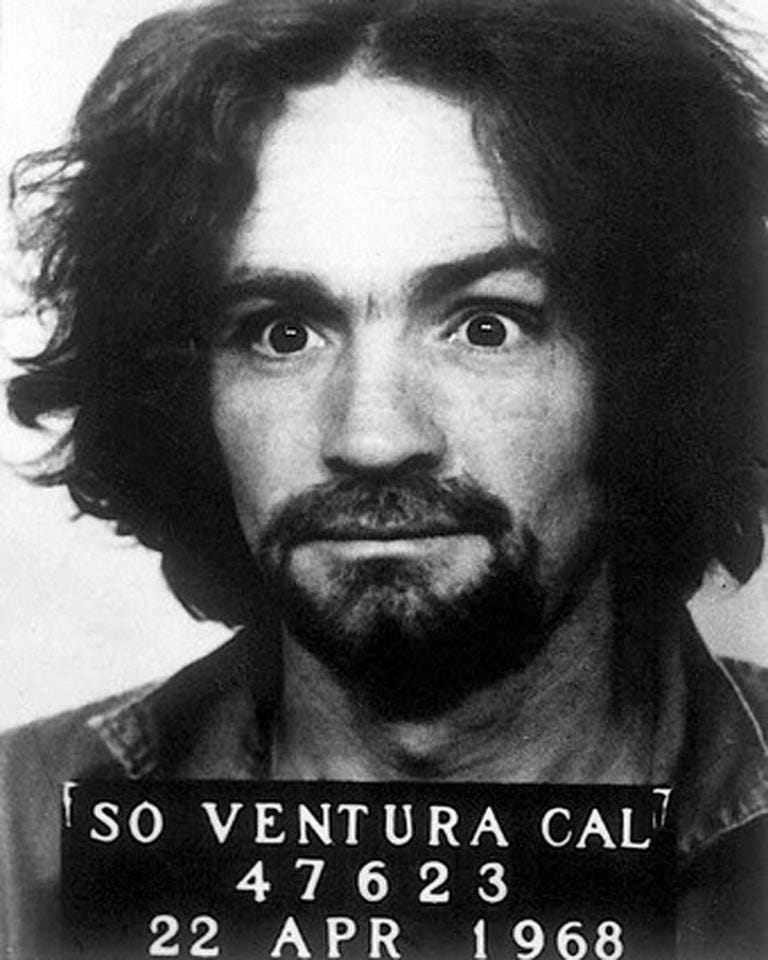
By the time Charles Manson was released on March 21, 1967, he had spent more than half of his 32 years institutionalized. Very sadly, he reportedly pleaded with authorities to let him stay, saying prison had become his home.
Less than a month after his release, he moved to Berkeley, California, where he was transferred from regular probation to the supervision of criminology doctoral researcher and federal probation officer Roger Smith, who worked at the Haight-Ashbury Free Medical Clinic. Smith, along with the clinic’s founder, David Smith, was receiving funding from the National Institutes of Health and, allegedly, through the CIA’s infamous MKUltra program, which illegally experimented on the effects of drugs on human behavior. What exactly that meant for Charlie Manson is highly disputed.
Through them, Manson took LSD, and he took it frequently. Soon, he was bringing his new friends (more on that shortly) to the clinic for free drugs. David Smith, alongside Roger Smith, who was studying the effects of LSD, wrote that the changes witnessed in Manson “were the most abrupt Roger Smith had observed in his entire professional career.”
Manson, who had learned to read in prison, had also begun dabbling in religion and philosophy while incarcerated. His listed religion in prison? Scientology. A 1961 prison report found that, through the nascent “religious” movement, Charlie “appears to have developed a certain amount of insight.” After his release, he met local Scientologists and completed more than 150 hours of Scientology auditing, or “processing,” essentially a Scientologist using an E-meter to ask structured questions about a person’s past life. Ultimately, Charlie turned away from the Church of Scientology.
Scientology influenced Manson, but so too did the science fiction novel Stranger in a Strange Land, the Bible, self-improvement writer Dale Carnegie, the Process Church of the Final Judgment, which believed the forces of Heaven and Hell would reconcile on Judgment Day and judge humanity together, the ongoing Summer of Love in 1967 during his first year of freedom, and, you know, a lot of LSD and marijuana. All of this contributed to his laid-back persona and the beginnings of a philosophy he called ATWA: Air, Trees, Water, Animals, and All the Way. Basically, nature was good, and humanity was destroying the world, which it was and is. The philosophy would evolve over time, but this was its foundation during the Summer of Love and into the tumultuous year of 1968.
Now, Charles Manson lacked genuine empathy and exhibited a deeply complex personality with possibly even psychotic tendencies. He was a psychopath, lacking any real moral conscience. But, like many of history’s most infamous criminals, he was enthusiastic, charismatic, outwardly calm, good at giving the illusion that he could read, understand, and help you, and, in his own way, intelligent. Those qualities made him an excellent manipulator, and paired with his overwhelming desire to finally be seen as someone important, someone special, after a lifetime of being shut away and insignificant, they made him a dangerous man, a dangerous man who made friends quickly.
His first follower was 23-year-old graduate student and University of California, Berkeley library assistant Mary Brunner. Soon after arriving in the area, the homeless Manson made a living panhandling when he wasn’t tripping balls on LSD. The disheveled, 5-foot-2 drifter met Brunner and, through his charm and animalistic attractiveness, began a sexual relationship with her. Before long, she was letting him stay in her apartment.
The couple soon became a throuple when Charlie met 19-year-old Lynette Fromme, a former child dancer and runaway who had been kicked out of her family’s Redondo Beach home for smoking dope and drinking. Suffering from depression, she was sitting dejected on a curb when Charlie Manson stepped off a bus, looked at her, and said, “Your parents threw you out, didn’t they?” Fromme, maybe high and definitely deeply depressed, immediately decided this man was a psychic and followed him home.
Brunner was not happy about sharing either her apartment or her man with another girl, but Charlie convinced her. Before long, Brunner had quit her job and abandoned her studies at Berkeley. Soon, more young women, many of whom had left comfortable middle- and upper-class backgrounds, joined the growing “Family.” This was the Charlie Manson they saw.
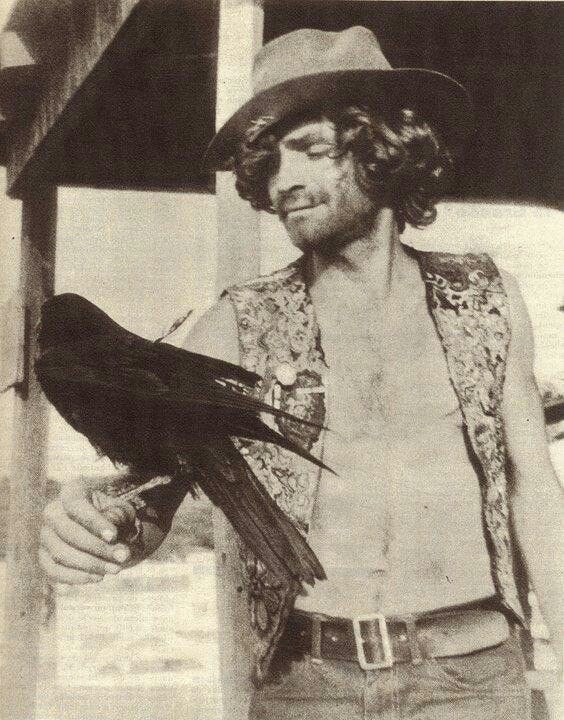
Thanks to his ostensible parole officer, Manson was kept from being returned to jail. He and his “friends” were doing a lot of drugs and were frequently high in public, and it seems that, on some level, Charlie was also pimping out some of his female followers. In 1967, Charlie befriended former Protestant minister Dean Moorehouse, who picked him up while he was hitchhiking. He also took an interest in Moorehouse’s 14-year-old daughter, Ruth Ann, who reciprocated that interest, and soon she was a member of the Family after running away from home. This resulted in a confrontation that led to Charlie’s arrest, but thanks to the LSD dispenser that was his Parole Officer, Charlie got off.
Manson became something of a guru. The local, well, hippies all became acquainted with the charismatic, long-haired little man. He was well-liked and was generally seen as harmless. Meanwhile, an increasing number of young, naive, insecure, and outcast women moved into Mary Brunner’s apartment alongside Charlie Manson. This was the Summer of Love, and there was a lot of loving. Brunner became pregnant by Charlie. The group of more than a dozen young women were enthralled by the man.
It is alleged that Charlie taught these women they were the reincarnation of the first Christians, with himself, of course, as Jesus, and the nebulous establishment as the Romans. With no income, Brunner was eventually evicted from her apartment, but the group managed to buy an old school bus on the cheap. They filled it with painted rugs, removed the seats, replaced them with pillows, cushions, and loveseats, and lived in it while roaming Topanga Canyon, Malibu, and Venice.
On April 15, 1968, Brunner gave birth to their son, Valentine Michael, named after the protagonist of Charlie’s favorite science fiction novel, Stranger in a Strange Land, in a condemned house they were squatting in at Topanga Canyon.
Around this time, he ended his relationship with the Haight Clinic. Director David Smith later wrote that Manson attempted to reprogram his followers’ minds to “submit totally to his will” through “LSD and unconventional sexual practices,” turning them into “empty vessels that would accept anything he poured.” Now, regardless of whether that is entirely true, and there is certainly truth to it, this man had been feeding the group LSD for almost a year.
With the same charisma, and with a gaggle of nubile young women whom he did not reserve solely for himself sexually, similarly, lost young men also joined the nascent group. One of them, teenager Paul Watkins, who later testified against the Family, stated that Charlie encouraged everyone else to take large doses of LSD but took lower doses himself to “keep his wits about him,” and that “Charlie’s trip was to program us all to submit.”
Regardless, by mid-1968, no one outside the Family saw this, and everyone inside it was totally devoted. Charlie followed through on his promise to Phil Kaufman and reached out to Universal Studios producer Gary Stromberg. Like almost everyone else, Stromberg found Charlie strange but harmless, and very, very interesting. He even consulted Manson about a film adaptation he was working on, centered on a Black Jesus in modern America. Charlie, girls in tow, had the women kiss his feet to demonstrate to Stromberg what it would be like to be Jesus in modern America.
Stromberg continued consulting Manson and, one day at Venice Beach, listened as Charlie preached to followers and strangers alike about the hell that was capitalism and materialism. When someone in the crowd called him out over the decked-out school bus if he was so opposed to material possessions, Charlie nonchalantly tossed the man the keys and told him it was his. The man actually took it, and Charlie simply kept preaching. Later, Stromberg said Charlie possessed extraordinary emotional intelligence. He could read people, determine what they lacked and what they needed, and then exploit those vulnerabilities to manipulate them.
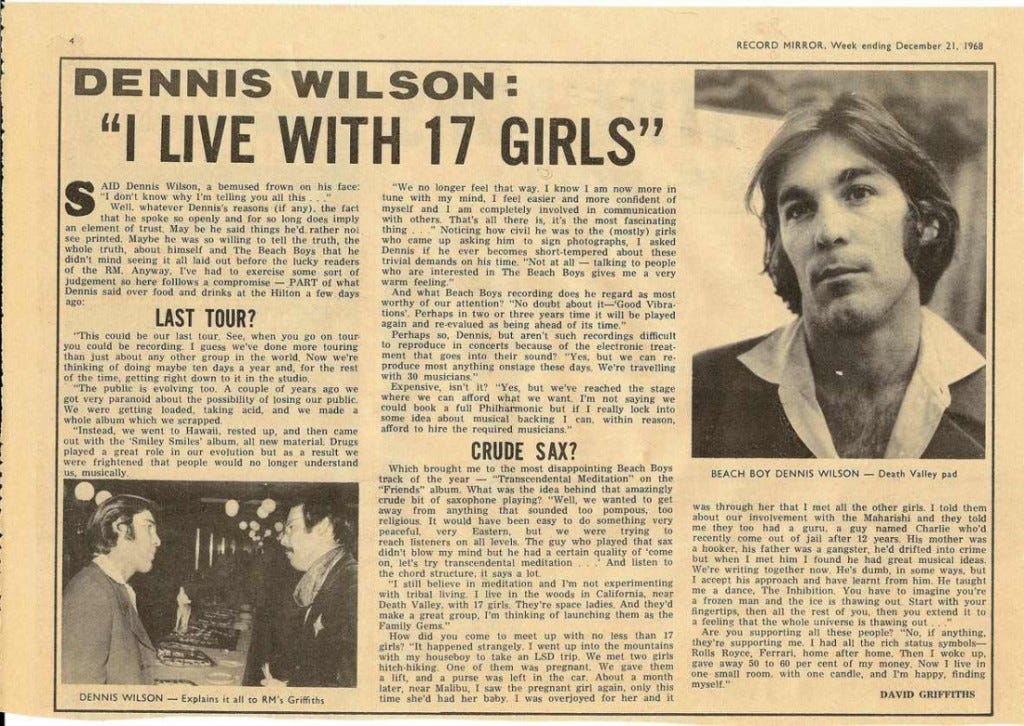
In the spring of 1968, 23-year-old Beach Boys drummer Dennis Wilson met 20-year-old Patricia Krenwinkel and Ella Bailey, both members of the Family. Krenwinkel, an L.A. native, had been relentlessly bullied as a child for being overweight and for an endocrine condition that caused excessive body hair. She eagerly abandoned the office job she held after meeting Charlie Manson, the two having sex the very first night they met. Like so many others, Krenwinkel became enamored with Charlie. She later described the Family’s early days as idyllic: “We were just like wood nymphs and wood creatures. We would run through the woods with flowers in our hair, and Charles would have a small flute.”
While hitchhiking around Los Angeles on April 6, 1968, she and Bailey were picked up by another laid-back hippie, Dennis Wilson, while they were tripping on acid. He gave them a ride and dropped them off. Five days later, he happened to run into them again while driving around. Wilson invited them back to his place, where they hooked up, and the girls told him they “had a guru, a guy named Charlie who’d recently come out of jail after twelve years.”
Wilson then left for a recording session, leaving the two girls alone in his Sunset Boulevard home. They immediately phoned the Family, and when Dennis returned home, Charlie Manson emerged from inside the house and walked toward him. Wilson asked if he intended to rob him, to which Charlie dropped to his knees and began kissing his feet. Inside, Dennis found twelve strangers, mostly young women, and, well, sex and drugs followed, Good Vibrations if you will.
Between Manson, the LSD and the young women, Dennis Wilson was fascinated. For the next six months he housed the Family, referring to Charlie as both a friend and “The Wizard” in a Rave magazine interview. Wilson covered their expenses, more than $100,000, including a massive bill for gonorrhea treatments and another $21,000 for the destruction of one of his cars. The pair sang together, played guitar together, treated the women as free-use servants, and Wilson paid for studio time so Charlie could record songs, even performing some of Charlie’s compositions himself.
Wilson introduced Manson to entertainment industry acquaintances such as producers Terry Melcher and Gregg Jakobson. Jakobson was impressed by the “whole Charlie Manson package,” singer-songwriter, guru, and lifestyle leader, and also invested money into recording Charlie’s material. Another man Charlie met was producer and landlord Rudi Altobelli, who rented out the 3,200-square-foot house with a swimming pool and two-story guesthouse at 10050 Cielo Drive, a home Charlie himself visited.
One of Charlie’s songs, “Cease to Exist,” was reworked into “Never Learn Not to Love” and released by the Beach Boys, with Manson receiving no songwriting credit. By then, Wilson had grown fed up with him. Asked why Charlie received no credit, Wilson explained that Manson had surrendered the rights in exchange for “about a hundred thousand dollars’ worth of stuff.”
Beach Boys frontman Mike Love recalled Dennis claiming he had seen Charlie shoot a Black man “in half” with an M16 and then hide the body. Wilson was, according to Love, “so freaked out he just didn’t want to live anymore. He was afraid, and he thought he should have gone to the authorities, but he didn’t, and the rest of it happened.” Beach Boys collaborator Van Dyke Parks recalled another incident:
“One day, Charles Manson brought a bullet out and showed it to Dennis, who asked, ‘What’s this?’ And Manson replied, ‘It’s a bullet. Every time you look at it, I want you to think how nice it is your kids are still safe.’ Well, Dennis grabbed Manson by the head and threw him to the ground and began pummeling him... I heard about it, but I wasn’t there. The point is, though, Dennis Wilson wasn’t afraid of anybody!”
Regardless, Wilson eventually abandoned his own house and moved into an apartment while the Family remained behind. They stole many of his remaining possessions before finally being evicted when the lease expired in the summer of 1968.
Charlie led the Family to the Spahn Movie Ranch, a 55-acre ranch in northwestern Los Angeles that had been used as a film set for decades. By the late 1960s, however, it had begun to fall into disrepair following the decline of filming, and its owner, George Spahn, was in his eighties and blind. With things in such a poor state, the Family seemed like a godsend to Spahn. The young, nubile women cleaned for him, guided him around the ranch, and had sex with him. Lynette Fromme was given the nickname “Squeaky” by Spahn for the sound she made when he ran his hand up her thigh.
One of the newest members of the Family was 22-year-old Charles Watson, a Texas native who had been an honor roll student, captain of the football team, and editor of his high school newspaper before becoming a fraternity brother at the University of North Texas. While visiting a fraternity brother in Los Angeles, he picked up a hitchhiker, Dennis Wilson. Hitchhiking used to be a lot more common. Through Wilson, Watson met Charlie Manson and, like so many others, became enthralled with him. He soon joined the Family at Spahn Ranch, where George Spahn nicknamed him “Tex” because of his accent.
Here, the group changed. What had begun as a, in a few words, problematic hippie commune evolved into a doomsday cult, with Charlie Manson becoming fixated on the idea of an imminent apocalyptic race war between white and Black Americans. As the Family watched the news throughout 1968 and saw race riots erupting across the country, it only strengthened their conviction in Charlie’s prophecies.
Charlie preached that Black people would rise up and kill all the white people, save for the Family. But, he argued, Black people were not intelligent enough to survive or govern on their own and would need a white man as their “master.” Naturally, that man would be Charlie, because, on top of everything else, Charles Manson was deeply racist. He also became obsessed with the Beatles, particularly their 1968 self-titled album, The Beatles, and its chaotic proto-heavy metal song “Helter Skelter.” He adopted the song’s title as the name for the coming race war. According to Paul Watkins, the Family, at Manson’s direction, even tried to create a musical album that would somehow trigger the race war.
In November 1968, for reasons I am not entirely sure of, perhaps to get out of Los Angeles because of the supposedly coming race war, Manson and part of the Family moved to Barker Ranch in Death Valley, isolated in the middle of the desert, while others remained at Spahn Ranch. Over the next several months, through late 1968 and into 1969, the Family became increasingly radicalized in their isolation while Charlie moved back and forth between the desert and Los Angeles.
On March 23, 1969, Charlie returned to 10050 Cielo Drive looking for Terry Melcher, only to learn from photographer and friend of the homeowners Shahrokh Hatami that Melcher no longer lived there. Inside the home was the 26-year-old actress Sharon Tate, who was pregnant. Her acclaimed but problematic husband (the serial cheating came first, the much worse revelations came later), 35-year-old director Roman Polanski, was away.
The likable and friendly Tate had a wide circle of friends and acquaintances, including Terry Melcher and her landlord, Rudi Altobelli. Seeing the scraggly-looking Manson approach, Hatami went to the door to find out what he wanted. He directed Manson toward the guest house beyond the main residence, where Altobelli sometimes stayed, then remained glued to the window to make sure the strange man left. Manson did depart shortly afterward.
But Charlie returned that evening. Finding no one in the main house, he walked to the guest house and, after first entering the enclosed porch, found Rudi Altobelli. Manson was looking for Melcher, presumably to discuss an album deal for the Family’s race war record, but Altobelli lied, claiming he had no idea where Melcher now lived. He also told Charlie he was leaving the country the next day, which he was, alongside Sharon Tate, flying to Rome.
When Charlie said he would like to speak with him upon his return, Altobelli replied that he would be gone for more than a year. Suspicious, he then asked Charlie how he knew he was staying there. Manson answered that the people in the main house had told him. Altobelli then asked Charlie not to disturb his tenants. Altobelli and Tate flew to Rome together the following day, and during the trip she asked him whether “that creepy-looking guy” had come looking for him the previous day. Tate in 1969.
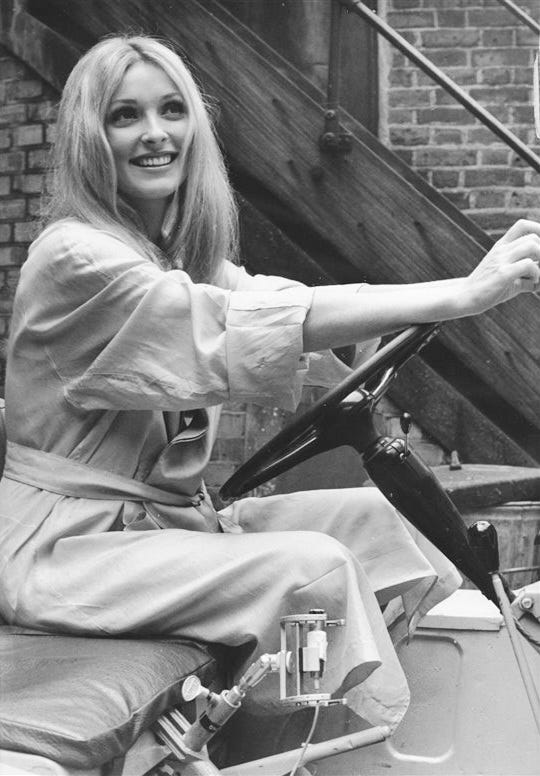
The well-educated Texan, Tex Watson, left the group in December 1968, though his life didn’t exactly improve. He moved in with a woman who sold marijuana and LSD, becoming a drug dealer alongside her until he realized this was somehow worse than the Manson Family, and returned to the Family.
He was ordered by Manson to “find money for Helter Skelter,” and through his ex-girlfriend’s business dealings, he stole money from a man named Bernard Crowe. Crowe called the Ranch and threatened the Family, only for Charlie to invite him to his Hollywood apartment, On July 1, 1969, Manson shot Crowe non-fatally with a .22-caliber Hi-Standard revolver. As Crowe was Black, Charlie erroneously believed he was a member of the Black Panthers and convinced the Family that this was the beginning of Helter Skelter. He brought in members of the Straight Satans Motorcycle Club at night to act as security, paying them in part through sexual favors from the girls.
Still needing money, Manson ordered the mother of his child, Mary Brunner; 20-year-old Susan “Sadie” Atkins, a former introverted church choir singer; and 20-year-old musician-turned-Family-member Bobby Beausoleil to go to the home of Beausoleil’s former roommate, 34-year-old music teacher and UCLA graduate student Gary Hinman. Manson believed Hinman was wealthy.
The three beat Hinman and held him hostage until Charlie arrived with a sword and slashed his face. After that, Beausoleil stabbed Hinman to death, allegedly, probably, on Manson’s instruction. Using Hinman’s blood, he or one of the women then wrote “Political Piggy” on the wall next to a panther paw, apparently attempting to implicate the Black Panthers. It should be noted that, according to Beausoleil, he went to Hinman’s house for a drug deal and the two women simply came along. He was arrested on August 6, 1969, for driving Hinman’s car, with the murder weapon found in the tire well.
Two nights after Hinman’s murder, Tex Watson, Susan Atkins, Patricia Krenwinkel, and 20-year-old Linda Kasabian arrived at 10050 Cielo Drive. Watson stated that Charlie had instructed him to go to the house and “totally destroy” everyone there, “as gruesome as you can,” and instructed the women to listen to Watson.
Inside were the 8½-month-pregnant Sharon Tate, Roman was away filming, her close friend and former boyfriend, celebrity hairstylist Jay Sebring, Polanski’s friend and writer Wojciech Frykowski, and his girlfriend Abigail Folger, heiress to the Folger coffee fortune. The four had spent a pleasant evening together, going to the El Coyote Mexican restaurant on Beverly Boulevard. Also on the property were caretaker William Garretson and his friend Steven Parent.
Arriving just after midnight on August 9, Tex Watson climbed a telephone pole near the main gate and cut the phone line to the house. The group backed their car down Cielo Drive to the bottom of the hill and then walked back up toward the house. For some reason, they thought the gate might be electrified and/or equipped with an alarm, so they climbed over a brushy embankment to the right of the gate and entered the grounds.
Almost immediately, headlights beamed toward them. It was Parent, the groundskeeper’s friend, leaving the property. Watson barked at the women to remain hidden in the bushes and stepped out, getting Parent to stop. Watson leveled the same pistol used to shoot Bernard Crowe through the open window at Parent, who begged Watson not to hurt him, saying he would be silent about what had happened. Watson instead lunged at him with a knife, giving him a deep slash wound to the palm that severed tendons and cut the wristwatch he was wearing. He then shot Parent four times in the chest and abdomen, killing him.
Watson turned off the ignition and pushed the car away from the gate. The four gunshots did not register with or alert anyone inside the house or in the surrounding homes. The group then moved toward the house, Watson cutting the screen of a window before telling Kasabian to keep watch down by the gate. She did so, standing near Parent’s murdered body and his car.
Watson removed the window screen and entered the home through it, opening the front door to let Atkins and Krenwinkel inside, all without awakening anyone, including Wojciech Frykowski, who was asleep on the living room couch. Watson awoke him with a kick to the head. Frykowski came to and asked who he was and why he was there. Watson replied, “I’m the devil, and I’m here to do the devil’s business.”
He sent Atkins and Krenwinkel, both armed with Buck knives, to find anyone else in the home. They returned with the heavily pregnant Tate, Sebring, and Folger, forcing them at knifepoint into the living room, where they were ordered to lie down. Frykowski had his hands bound behind his back with a towel, while Watson began tying the women together by their necks with a length of nylon rope he had brought with him, slinging it over the living room’s ceiling beams.
Jay Sebring protested, pleading with them to consider Tate’s condition and the fact that she was extremely pregnant. Sources differ on what happened next. One says Sebring made a move on Watson while he was tying the nylon rope. Alerted by Susan Atkins, Watson shot Sebring and then, during a struggle, stabbed him seven times. Another account ends the same way, but without a struggle. Regardless, Jay Sebring was the first to be killed. His face was disfigured, and a long nylon rope was placed around his neck and then hung over the living room’s ceiling beams.
Folger attempted to talk them out of the senseless murder by appealing to their greed, and Krenwinkel took her to a bedroom to retrieve her purse.
Meanwhile, in the living room, Frykowski managed to break free from the poorly tied towel restraint and began struggling with Atkins, who stabbed him in the legs multiple times. He made it out the door and onto the porch, but Watson struck him twice over the head with the gun, then stabbed him repeatedly on the ground before shooting him. Frykowski continued fighting, struggling across the lawn before Watson finally killed him.
Inside the house, Folger escaped from Krenwinkel through a bedroom door and made it to the pool area before Krenwinkel caught her, stabbed her, and tackled her to the ground. The noise brought Tex Watson running, and the pair killed her.
At some point, I believe around here, Linda Kasabian told Susan Atkins that she heard someone coming and that they needed to leave, ostensibly in an attempt to get the killing to end.
Inside the home, poor pregnant Sharon Tate could do nothing but listen to the horrifying sounds of the murders. With her hands tied and the phone line cut, she pleaded not necessarily for her own life, but for the life of her unborn child, offering herself as a hostage until she could give birth. But the Family had no mercy. Tate was stabbed 16 times and then hanged next to Sebring. At the coroner’s inquest, it was determined that she was still alive when they did so, Tate ultimately dying from massive hemorrhaging.
Watson said that Manson had instructed the women to “leave a sign, something witchy,” and so Atkins wrote “pig” in Tate’s blood. Atkins later claimed she did this to imitate the scene of Hinman’s murder in the hope of getting Beausoleil out of jail.
The group left to return to Charlie. The five murdered people at 10050 Cielo Drive were discovered the following morning by Tate’s housekeeper. Police took the only “survivor,” property caretaker William Garretson, in for questioning. Garretson had said goodbye to his friend Parent and gone into the guest house where he lived on the property. The police interrogated him, but he was eventually released, and, obviously, as we now know, he had nothing to do with the murders. Body of Sharon Tate being removed.
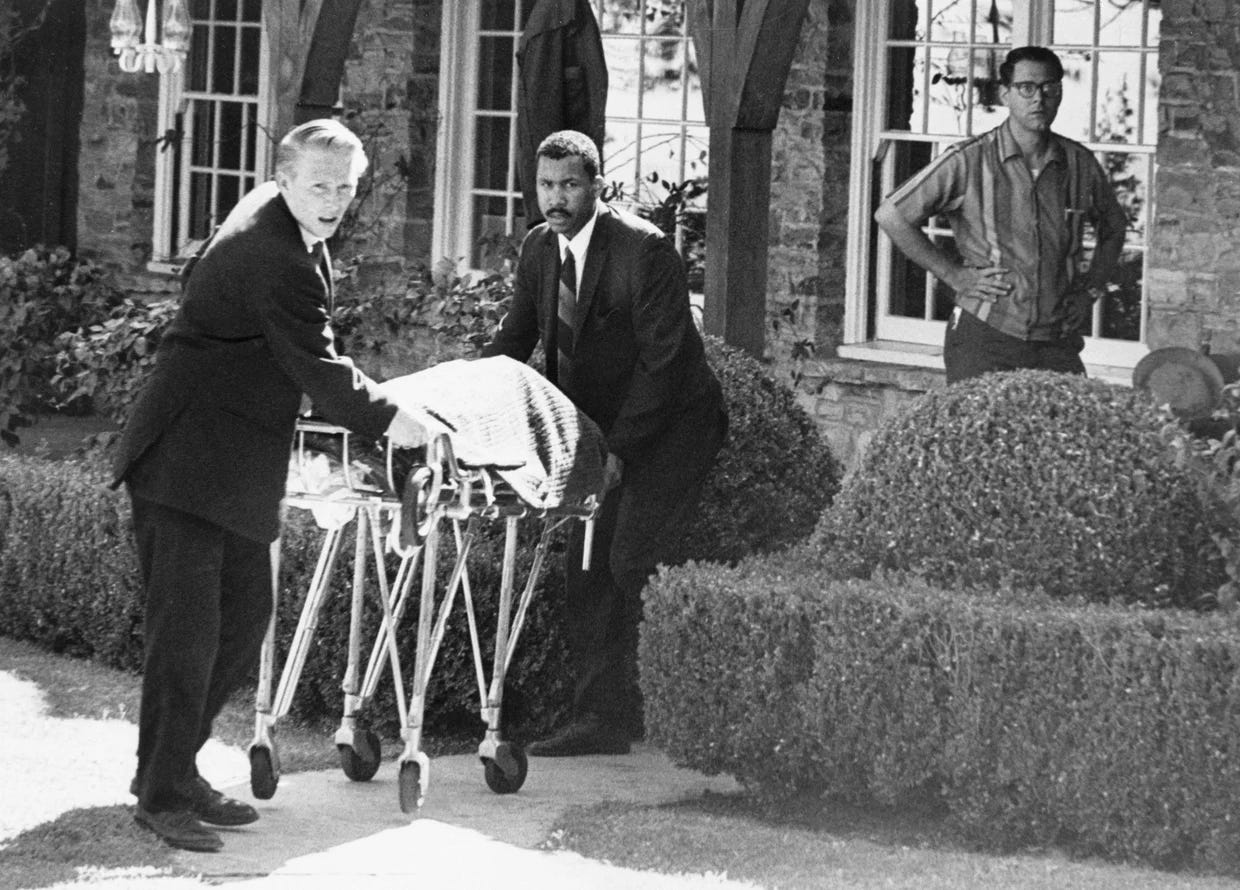
The next night, those four, plus Charlie Manson, 19-year-old Leslie Van Houten, another runaway from a middle-class background, and 18-year-old Steven Clem Grogan, considered by others in the Family to be mentally disabled, went for a drive. Manson was displeased with the murders the previous night, the panic in the Family, and how they had allowed two of the victims to flee into the yard. He instructed Kasabian to drive them to 3301 Waverly Drive in Los Feliz, the home of supermarket executive 44-year-old Leno LaBianca and his dress-shop-owning wife, 43-year-old Rosemary.
Both Kasabian and Atkins testified that Manson disappeared up the driveway and returned saying he had tied up the home’s occupants. Watson, however, claimed that Manson returned to the house with only him, entering the house through an unlocked back door. Watson said Manson roused the sleeping Leno LaBianca at gunpoint and had Watson bind his hands with a leather strap, while Rosemary was brought into the living room from the bedroom. They covered the couple’s heads with pillowcases, binding them into place with lamp cords. Manson then left, and Krenwinkel and Van Houten entered.
Watson sent the women from the kitchen to the bedroom with Rosemary LaBianca. In the living room, he began stabbing Leno with a bayonet, the first strike entering his neck. He then heard noises coming from the bedroom and entered to find Rosemary somehow fending off the two women. He ended this resistance with several bayonet stabs before returning to the living room to continue the attack on her husband, eventually carving the word “War” into his abdomen.
Watson returned to find the two female Family members stabbing Rosemary over and over, many of the wounds inflicted after she was already dead. Watson cleaned the bayonet and took a shower in the home while Krenwinkel wrote “Rise” and “Death to Pigs” on the walls and refrigerator, all in LaBianca’s blood. She then went to the already dead Leno and stabbed him with a carving fork, which she left jutting out of his stomach. She also planted a steak knife in his throat.
Meanwhile, Manson drove the other three to the Venice home of actor Saladin Nader, leaving them, and the LaBianca trio, to hitchhike home. According to Kasabian, she deliberately led them to the wrong address. Regardless, Nader was not killed, while leaving, Atkins took a shit in the middle of a stairwell.
The murder of a high-profile actress, the wife of an even higher-profile director, as well as the heiress to a fortune, combined with the horrific nature of the killings, made it sensationalized national news. While detectives were quick to draw similarities between the Hinman killing and the Tate murders, noting the use of some of the same weapons, they initially believed the Tate murders were the result of a drug deal gone wrong, leading the investigation in the wrong direction. The LaBianca murders were discovered on the night of August 10, and two days later the LAPD ruled out any connection between the two killings.
Four days later, Spahn Ranch was raided, not in connection with the murders, but on totally unrelated auto-theft charges. While Manson and 25 other Family members were arrested and guns were seized, the search-warrant paperwork was misdated, and so the group walked.
Working totally separately, the teams investigating the Tate and LaBianca murders made little progress.
Now, I cannot dive into each assertion, but it is suspected and speculated that the Family committed many more murders. The LAPD believed they may have been responsible for as many as 12, while one detective asserted that Manson repeatedly insisted he had killed many more. Manson once told a cellmate that he was responsible for the deaths of more than 35 people. He also sent Sharon Tate’s younger sister a taunting map of the Panamint Range in Death Valley with crosses drawn on it, supposedly to represent buried bodies, though no bodies were ever found.
Manson would claim many more, doing anything for attention, but I think it is certain they killed more than the eight victims mentioned already. Then there was the late-August killing of a former Spahn Ranch stuntman who had become the de-facto foreman of the ranch. He initially got along well with the Family, but Charlie looked down on him because he, a white man, was married to a Black woman, and again, Manson was terribly racist. After the raid, which led Charlie to believe he was a “snitch,” he was killed on August 26, 1969. His remains were not found for eight years.
The end came rather extraordinarily through a completely unrelated investigation. The Family had burned an earthmover owned by Death Valley National Park, and there was evidence of the theft of dune buggies in the area. This resulted in a joint park ranger and Inyo County Sheriff’s Office raid on the Death Valley ranch, resulting in the arrest of two dozen people, including Charlie Manson, who was found hiding beneath a bathroom sink.
The LaBianca team, stumped, finally began asking around about similar crimes. This was how they learned of the Hinman murder in mid-October, and through that investigation they learned that Hinman’s murderer, Bobby Beausoleil, had a girlfriend who had been arrested at the desert ranch. They kept asking around about the Family, hearing about them from members of the motorcycle gang hired to work as bodyguards.
In jail, Susan Atkins talked to her roommates, one of whom told police what she had said. This led to Atkins being interrogated, and she let slip that she had been present and involved in the Hinman murder. She was sent to another detention center, where she couldn’t keep her mouth shut, and again told fellow prisoners, who then told authorities.
From this, on December 1, warrants were issued for the arrests of Watson, Krenwinkel, and Kasabian. None of the three had been arrested in the raid, and all had fled after the Family’s dissolution. Watson and Krenwinkel were picked up in McKinney, Texas, and Mobile, Alabama, respectively, while Linda Kasabian voluntarily surrendered to authorities the next day in Concord, New Hampshire.
Physical evidence tied Watson and Krenwinkel to the Tate murders. Kasabian, as it was learned, had no direct participation in the killings, and she was granted immunity from prosecution in exchange for her testimony. It had not taken investigators long to tie the crimes to Charlie Manson.
The trial that followed was as farcical as their crimes had been horrific. Left to right, Patricia Krenwinkel, Leslie Van Houten and Susan Atkins arrive at the trial.
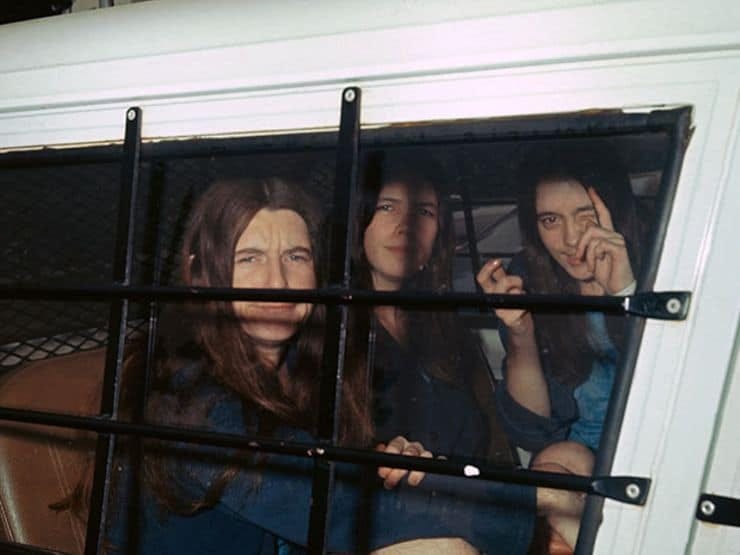
Charlie Manson was initially given permission to act as his own attorney, but due to his bizarre and nonsensical pretrial motions, that permission was withdrawn before the trial began. Manson responded by filing an affidavit of prejudice, which resulted in the original judge being replaced.
The trial began on June 15, 1970. The Family made their presence known, loitering around the entrances and corridors in their distinctive clothes and had to be subpoenaed as prospective witnesses simply to keep them from disrupting proceedings, which legally prevented them from entering the courtroom. They sat outside the courthouse carrying sheathed hunting knives, which, remarkably, was perfectly legal.
When Manson appeared in court with a buzz cut, he had an X carved into his forehead. He explained that because he was “considered inadequate and incompetent to speak or defend myself,” he had “X’d myself from your world.” His followers, both the defendants and those still free outside, followed suit and carved Xs into their own foreheads.
Some also threatened or attempted to prevent former members from testifying. Paul Watkins was badly burned when a fire was set to his van. Barbara Hoyt, who had reluctantly agreed to testify and was still debating whether to turn against the Family, was invited by Ruth Ann Moorehouse to accompany her on a trip to Hawaii. Hoyt later said she was drugged by Moorehouse with several doses of LSD, resulting in a hospitalization. She subsequently testified against the Family.
The prosecution argued that triggering “Helter Skelter,” Manson’s imagined apocalyptic race war, was the primary motive for the murders. The defendants, however, offered another explanation: the writing in blood was intended to copy the Hinman murder scene.
On August 4, despite precautions taken by the court, Manson somehow managed to flash the jury the front page of the Los Angeles Times, whose headline read, “Manson Guilty, Nixon Declares.” This referred to a statement made the previous day by President Richard Nixon, who had condemned what he saw as the media’s glamorization of Manson. Judge Charles Older questioned the jurors individually, and they maintained that Nixon’s remarks had not influenced them. The next day, the female defendants stood up and declared in unison that, in light of Nixon’s comments, there was no point in continuing the trial.
On October 5, Manson was denied permission to question a prosecution witness. Manson responded by leaping over the defense table and attempting to attack the judge. Bailiffs wrestled him to the ground and removed him from the courtroom, followed by the female defendants, who had risen and begun chanting in Latin. Afterward, Judge Older allegedly began wearing a revolver beneath his robe.
On November 16, the prosecution rested its case. Three days later, the defense stunned everyone by resting as well. Atkins, Krenwinkel, and Van Houten screamed that they had a right to testify. Their attorneys told the judge that their clients wanted to testify that they had planned and committed the murders themselves and that Manson had not been involved. They were standing by Charlie until the end.
By resting their case, the defense attorneys had attempted to prevent this. Van Houten’s attorney, Ronald Hughes, vehemently stated that he would not “push a client out the window.” From the prosecution’s perspective, however, it was Manson who was advising the women to testify in this way as a means of saving himself. Krenwinkel later summarized in a 1987 documentary, saying, “The entire proceedings were scripted, by Charlie.”
The next day, Manson testified, with the jury removed from the courtroom. Deputy District Attorney Vincent Bugliosi, writer of Helter Skelter, wanted to prevent Manson from making statements that might implicate his co-defendants or using his charisma and manipulative abilities to influence the jury. Speaking for more than an hour, Manson said, among other things, that “the music is telling the youth to rise up against the establishment.” He asked, “Why blame it on me? I didn’t write the music.”
As the trial dragged toward its conclusion, defense attorney Hughes simply disappeared, resulting in a delay while a new attorney became acquainted with the case. Hughes was later found dead in a ravine; his murder remains officially unsolved, though the circumstances led to immediate speculation that the Family had killed him in retaliation.
Atkins, Krenwinkel, and Van Houten testified that the murders had been conceived as “copycat” versions of the Hinman murder. According to this version of events, the plan had been conceived and carried out under the guidance not of Manson, but of Linda Kasabian, who was supposedly acting out of love for Beausoleil. There were enormous holes in this story. Among them was Atkins’ inability to explain why, if the whole point was to imitate the Hinman murder, she had written “political piggy” at the Hinman house in the first place. The attempt to exonerate Manson failed. Midway through the penalty phase, Manson shaved his head and trimmed his beard to a fork. He told reporters, “I am the Devil, and the Devil always has a bald head.”
On March 29, 1971, the jury returned death sentences for all four defendants on all counts. On April 19, Judge Charles Older sentenced Manson, Atkins, Krenwinkel, and Van Houten to death. In 1972, the California Supreme Court ruled in People v. Anderson that the state’s death penalty was unconstitutional, invalidating all death sentences imposed before its ruling. Manson, Atkins, Krenwinkel, Van Houten, and Watson therefore had their death sentences commuted to life imprisonment.
The Family continued to exist in various forms. Lynette “Squeaky” Fromme remained one of its most devoted members, writing letters to those still imprisoned and eventually moving to Sacramento to be closer to Manson, who was being held at Folsom State Prison. In 1975, Fromme made a farcical attempt to assassinate President Gerald R. Ford. She had managed to get a loaded pistol into position, but, as it turned out, she did not know she needed to pull back the slide to chamber a round. She was quickly arrested. Her attempted assassination was partly intended as a statement on pollution. She spent decades in prison before being paroled in 2009, after which she largely disappeared from public life. In a 2019 interview, she said she was still in love with Charlie Manson.
Mary Brunner, cooperated with authorities during the Hinman case but later served prison time for a spectacularly unsuccessful attempt to free Manson. The former graduate student was released in 1977 and has lived almost entirely outside the public eye since. Linda Kasabian, whose testimony was instrumental in convicting the others, likewise lived a quiet life after the trial and died in 2023.
Steven “Clem” Grogan was eventually paroled after helping authorities locate the remains of Donald “Shorty” Shea. Bobby Beausoleil remains imprisoned; at his 2025 parole hearing, officials found that he continued to minimize aspects of his actions and lacked sufficient insight into the violence. Tex Watson took another path, becoming a born-again Christian and expressing remorse, saying, “My heart is filled with remorse,” though authorities have continued to question the depth of his rehabilitation. He remains imprisoned.
Leslie Van Houten spent her decades in prison trying to change. She earned several degrees, participated in rehabilitation programs, accepted responsibility for her actions, and repeatedly expressed remorse. In 2023, after more than five decades behind bars, she was finally released, with the parole board citing her insight and genuine remorse.
Patricia Krenwinkel has repeatedly expressed remorse, by accounts pursued rehabilitation, and worked to understand the person she was when she committed those crimes. In 2025, the parole board recommended her release. Governor Gavin Newsom rejected it. I have suspicions about the political calculation involved in keeping one of the most infamous Manson Family members behind bars.
I don’t know what I believe about second chances for murders, especially as horrific as these. The horror of what happened cannot be overstated. And that is worth remembering, because this entire piece has been about the Family. We have spent thousands of words on Charlie Manson, his followers, their beliefs, their crimes, their trial, and what became of them. The victims, meanwhile, have necessarily been reduced to names and moments in a much larger story.
But Sharon Tate was not simply the pregnant woman murdered at 10050 Cielo Drive. Jay Sebring was not simply another body in the living room. Abigail Folger, Wojciech Frykowski, Steven Parent, Leno and Rosemary LaBianca, Gary Hinman, and Donald Shea were not supporting characters in the story of Charles Manson. They were people. They had families, friends, ambitions, loves, fears, personalities, and entire lives ahead of them. Those lives were brutally taken from them.
Like the Branch Davidians, the Manson Family contained people who were, in their own way, victims. They were vulnerable, they were isolated, they were manipulated, and many of them were psychologically warped by Manson and the environment he created. Understanding that matters. It helps us understand how ordinary, damaged, lonely, or searching people can become capable of extraordinary cruelty. But being manipulated does not erase responsibility. They still chose to participate. They still killed. And understanding why someone commits a terrible act should never become an excuse for the act itself.
The same is true of Manson. He was not well. He had a profoundly damaged childhood, spent much of his life institutionalized, and developed an extraordinary ability to identify vulnerable people and manipulate them. But rather than being an insane monster who had no idea what he was doing, Manson repeatedly demonstrated that he understood the power he had over other people. He leaned into the madness because it brought him attention. He denied responsibility, contradicted himself, mocked the crimes, manipulated the press, and continued the charade for decades.
A 1961 prison report described him as having a “tremendous drive to call attention to himself.” He certainly achieved that. Charlie Manson died on November 19, 2017, at the age of 83, after suffering cardiac arrest brought on by respiratory failure associated with colon cancer. He got what he wanted. He became famous.
More than that, he became a cultural icon. That may be the most disturbing part of the entire story. Lurid true crime can become crime porn very easily. We can become so fascinated by the murderer that the murderer becomes more memorable than the murdered.
I hope this piece has not done that, but there is value in understanding crime. There is value in understanding the psychology of people who commit terrible acts, the vulnerabilities they exploit, and the circumstances that allow those acts to happen. If we refuse to understand those things, we risk turning monsters into something almost supernatural, caricatures, fictional even, rather than recognizing that they are human beings who made horrific choices.
Understanding how Charlie Manson became Charlie Manson matters. But remembering what Charlie Manson did to other people, victims and followers both, and how he did it matters more.
Note: Thank you for making it to the end! As I’ve said before, this was always meant to be entertaining rather than academic. My goal is to make history both educational and entertaining, the kind of history that first captured my imagination as a kid. Thank you for reading and for coming along on this journey. If you’ve made it this far, just know, I love you.
Yep and we love you back. I was glad to read this and still can't believe it. I have 3 theories about it.
1. It's terrible what childhood trauma does to people.
2. All the "souls" connected to it had decided together on a soul agreement to come to the planet and "act out this terror" in the same way Stephen King imagines his novels and writes them out.
3. This story is, like all other physical experiences of the world and univers, are merely the result of our "tiny mad idea" that the Child of God (Our collective consciousness) believes they can be separated from their Creator. IE It's all a dream/nightmare from which we awaken realizing, "OMG, it was all a dream!"
This was a great read. Holy hell is it terrifying at the same time.