Hare-brained History Volume 71: Trial By Combat
Well, it's about one specifically, but not the famous one. This is how you market.

Welcome to the 71st installment of Hare-brained History, a blog in which your intrepid host will treat you with absurdities, follies, mind-fucks, and everything in between from the world of history. Today, we are inspired by a television show. Imagine that.
A new series has brought us back, triumphantly, to my favorite fictional universe: George R. R. Martin’s A Song of Ice and Fire. Specifically, it’s the recent adaptation of The Hedge Knight. And because this is not Wet-Brained Westeros, I will attempt, heroically, to restrain myself.
In the new show, the young hedge knight (maybe not) Ser Duncan the Tall gallantly defends an innocent puppeteer who is being assaulted by a sadistic prince. Unfortunately, the poor cannot strike the rich, even when it’s deserved, in any universe. Dunk is arrested and, rather than submit to a biased trial that would almost certainly end in his mutilation, he invokes his right as a knight: a trial by combat.
Suffice it to say, Dunk prevails. The prince withdraws his accusation. Good triumphs, though in George R. R. Martin’s universe, victory is rarely clean, and the brutality of medieval combat is laid bare. What you may not know is that trial by combat was very real.
The most famous example occurred in December 1386, when the French knight Jean de Carrouges accused his former squire, Jacques Le Gris, of raping his wife. Le Gris denied the charge and demanded a judicial duel to settle the matter. Carrouges won. Had he lost, not only would he have been executed, but his wife, pregnant at the time, would have been burned for false accusation. Just watch The Last Duel for that story.
But today, we turn to a more obscure judicial duel, one briefly referenced in that film. We are heading to Ypres, in medieval Flanders, for the clash between Guy of Steenvoorde and Iron Herman.
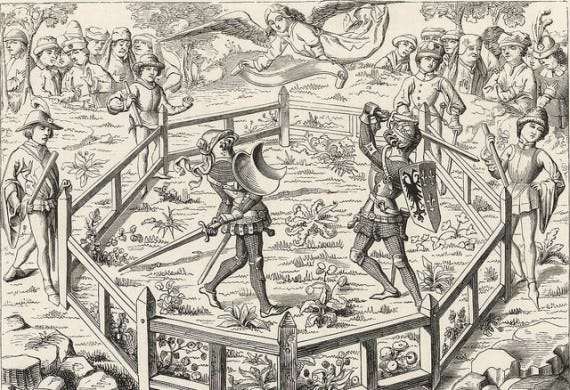
Trial by combat, or judicial duels, belongs to the broader family of trial by ordeal, which has ancient and widespread origins. Ordeals are attested as far back as the Code of Hammurabi, composed sometime between 1755 and 1751 Betty Crocker, older than Tutankhamun.
Ordeals by fire were used in ancient Persia and India. One of the simplest forms required the accused to swear an oath and then ingest sulfur, something I hope you are aware should not be consumed. Among ancient Iranian Zoroastrians, trials by fire were especially popular; there were dozens of variations, reflecting the belief that fire was associated with asha: cosmic order and righteousness.
Elsewhere, different cultures devised their own divine tests. In parts of West Africa, both accuser and accused might be required to retrieve an object from boiling oil; the one whose hand was least burned was judged to be in the right. Makes sense to me. The Franks, in the 6th-century Salic Law, prescribed a similar ordeal using boiling water. And, much later, Europeans employed the infamous “swimming test,” tying up women and throwing them into water to see if they floated, proof that they were a witch.
All of these practices reflect the same underlying concept: judicium Dei, the judgment of God. The belief was that God would not allow an innocent person to be falsely condemned.
Interestingly, trial by combat was unknown in the laws of the Anglo-Saxons, Roman, Mesopotamians, Indians, Egyptians, Chinese, Africans, or Jews. We do not know precisely when or how the practice developed, but it emerged among Germanic tribes under the same theological logic as other ordeals: victory was divine judgment, and the outcome was legally binding. It reflected a warrior society in which martial prowess and moral worth were seen as intertwined, and in which fighting to clear one’s name preserved honor.
It was in use among the Alamanni as early as the first centuries AD, and a few centuries later among the Burgundians, Lombards in northern Italy, and the Swedes, where it was known as holmgang. The earliest codified reference appears in the Lex Alamannorum, written between 712 and 730 AD. It prescribed combat as a method of resolving land disputes: a handful of the contested soil would be brought to the field, each party would touch it with their weapon and swear their claim was just, and then they would fight. The loser forfeited the claim and paid a fine, even if he died; in that case, his heirs inherited the penalty.
Under Louis the Pious, son and co-emperor of Charlemagne, it was permitted that champions could fight on behalf of the accused and accuser. Sound familiar?
Wherever Germanic peoples settled, trial by combat followed: the Holy Roman Empire, France, northern Italy, the Low Countries, Scandinavia, and England after the Norman Conquest. In 1216, Pope Honorius III urged the Teutonic Knights to suppress the practice, and over time, it began to fade.
The last recorded trial by combat in England occurred in 1446, when a servant accused his master of treason; the master, having pregamed too hard, was killed by his servant. The final trial by combat held under the authority of an English monarch took place in Ireland on September 7, 1583. Yet the practice was not formally abolished in Great Britain until 1819.
Nor is the idea entirely foreign to modernity. Dueling functioned as a kind of extra-legal honor combat well into the 19th century. In 1983, in McNatt v. Richards, the Delaware Supreme Court rejected a defendant’s request for “trial by combat to the death.” In 2020, David Zachary Ostrom petitioned for trial by combat in an Iowa custody dispute. Naturally, a court-ordered psychological evaluation followed, but upon passing it, his parenting time was restored; he later admitted the request was largely an attempt to draw media attention to his case to influence a ruling in his favor.
And, on January 6, 2021, human garden gnome Rudy Giuliani stood in Washington, D.C., and declared, “Let’s have trial by combat,” in response to allegations of voter fraud. The crowd was uninspired; the crowd listening to Giuliani’s client, however, were.

Our story begins in Denmark, where King Canute IV, an ambitious yet devout Catholic king and former Viking, married Adela, daughter of the Count of Flanders, in 1080 upon his accession to the Danish throne. The marriage strengthened his political position, but his reign proved turbulent.
Canute worked to expand the power of the Catholic Church in Denmark, a move that made him unpopular among those who still clung to Norse traditions, particularly among the peasantry. At the same time, his efforts to strengthen royal authority and enforce laws against noblemen who considered themselves above them earned him enemies within the aristocracy. It therefore came as little surprise that in 1086, inside Odense Cathedral, Canute was assassinated.
His widow, Adela, fled with their three young children, twin daughters and a son, Charles, to the court of her father in Flanders. Adela was soon married off to the Norman Duke of southern Italy, as women in feudal Europe were often little more than bargaining pieces. Charles and his sisters remained in Flanders.
Records of Charles’s youth are scarce, but he was reputed to be devout and well-liked. In his early twenties, he joined Danish and Flemish crusaders traveling to the Holy Land in 1107, then under Christian control following the First Crusade. He evidently made a strong impression. Seventeen years later, after returning and becoming Count of Flanders in 1119, Charles was offered the crown of the Kingdom of Jerusalem. The throne was then held by Baldwin II, meaning acceptance would have meant war. Charles declined, preferring to remain a count rather than become a king. The following year, in 1125, he reputedly refused another extraordinary offer: the title of Holy Roman Emperor.
Later that year, Flanders was struck by famine. Charles ordered crops planted on his own estates and distributed to the starving. He halted wine purchases and redirected the funds toward food relief. According to the chronicler Galbert of Bruges, Charles often declared it better for the rich to drink water than for the poor to starve. He distributed bread widely and punished those who engaged in the common practice of hoarding grain to inflate prices. At the same time, he expelled the Jews from Flanders under antisemitic accusations that they were hoarding wealth. Naturally then, Charles would be canonized as a saint and remembered as Charles the Good.
At the urging of his advisers, Charles also initiated legal proceedings to curb the power of the immensely wealthy Erembald family of Bruges, who were deeply involved in the grain trade and political maneuvering. In response, the family’s head, the unfortunately named Bertulf, a Catholic priest, organized a conspiracy to assassinate Charles and eliminate his allies.
On March 2, 1127, while Charles was attending Mass in the Church of St. Donatian in Bruges, knights aligned with the Erembald family entered the church and murdered him.
It was not a wise move. The brutal and sacrilegious killing of a popular ruler during a famine provoked immediate mob violence. Supporters of the Erembalds were hunted down and killed, accusations flew across Flanders, and the family was besieged in their castle by the people of Bruges and Ghent. King Louis VI of France seized the opportunity. He intervened, broke the siege, captured members of the Erembald family, and had them tortured and executed. He then installed his own preferred candidate as the new Count of Flanders, tightening French influence over the region. Image of Charles I on his reliquary in Sint-Salvatorskathedraal, Bruges, Belgium
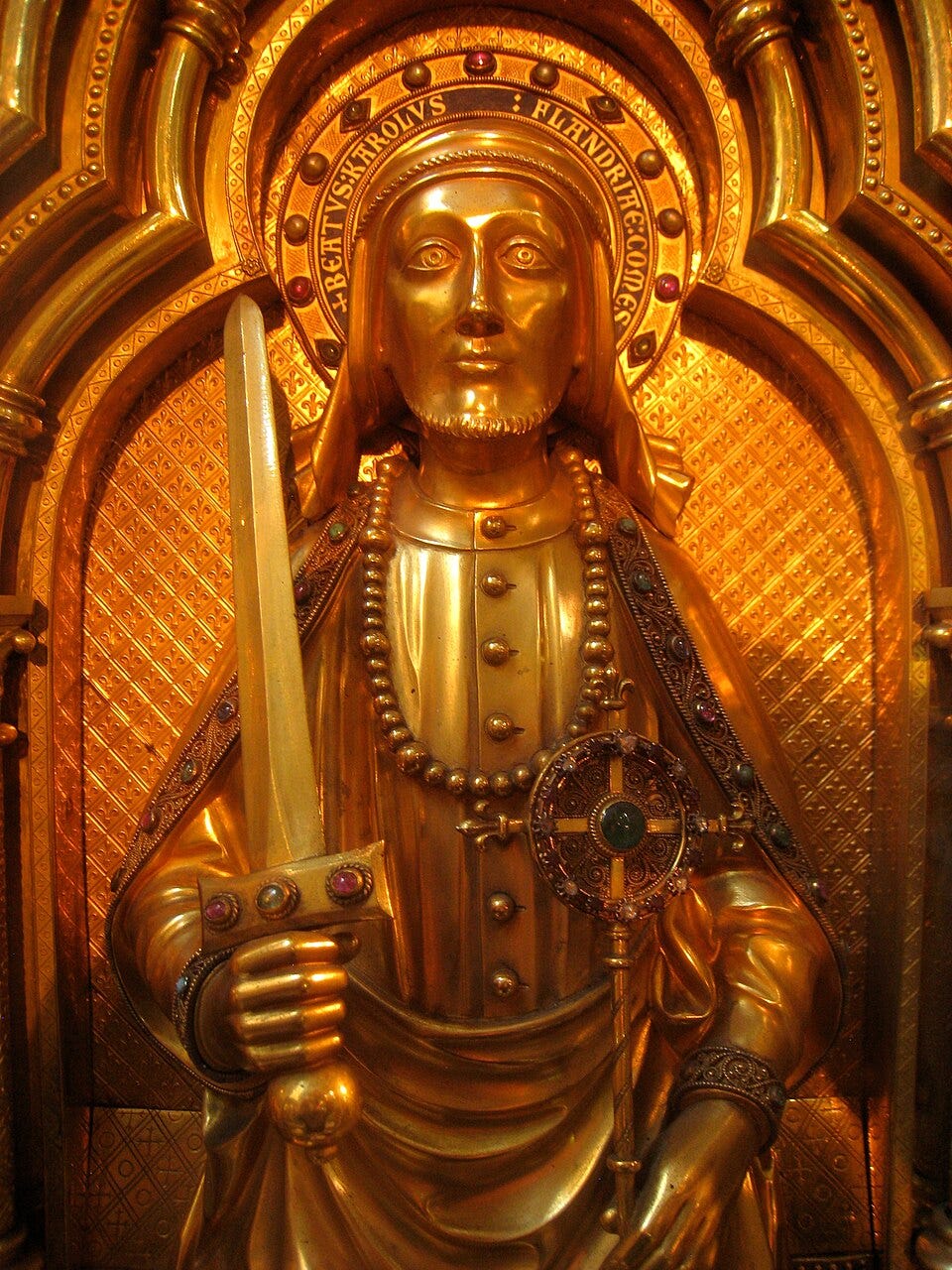
Galbert of Bruges describes the atmosphere of violence that followed the murder:
“Among so many dangers during the night and so many conflicts during the days that I, Galbert, since I had no place for writing, noted down on tablets a summary of the events that were going on until at some longed-for moment of peace, during night or day, I could set in order the present description according to what had happened.”
In the aftermath, in the town of Ypres in Flanders, one of the conspirators was executed. Whether by association, he was married to the conspirator’s niece, or because his name was given under torture, Sir Guy of Steenvoorde, described as “a famous and strong knight,” was accused of involvement in the plot. He denied the charge.
Whether the demand came from Guy himself or from the opposing knight, Sir “Iron” Herman, a trial by combat was arranged on April 11th, 1127. A crowd immediately followed the two men to a nearby farm, where the duel would be fought.
Two contemporary sources describe the combat: Galbert of Bruges and Walter of Thérouanne. The outcomes in both accounts are the same, but the paths to them differ.
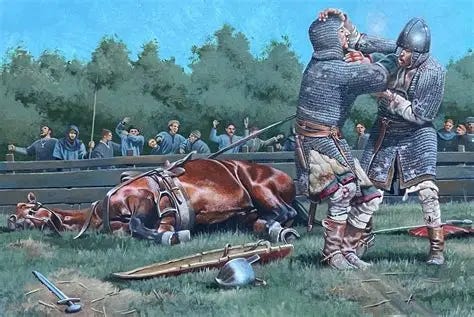
Galbert describes the combat in vivid detail. The two knights began on horseback, lances drawn, rounding and crashing together in brutal charges. Lances splintered, shields rang, and the field churned beneath the pounding of hooves. At last, Guy struck Herman hard enough to unhorse him. Herman hit the ground, and for a moment Guy held him there, thrusting with his lance, keeping him from regaining his feet.
But Herman rose, driving his sword into Guy’s horse, killing it beneath him and dragging the fight down into the dirt. Now both men stood on foot. They closed with swords in what Galbert calls “a continuous and bitter encounter,” blades hacking and ringing in close quarters. Steel gave way to grappling; the duel devolved into a wrestling match, armored bodies straining and slipping in the mud.
Herman fell onto his back. Guy hurled himself atop him and began battering his opponent’s face with his gloved fists. Yet, as Galbert writes, “just as one reads of Antaeus, the prostrate man gathered strength bit by bit from the coolness of the ground and slyly made Guy think he was certain of his victory.” Like that Greek mythological giant, who drew strength from the earth, Herman seemed to revive as he lay pinned.
Then, in a sudden and desperate movement, Herman “grabbed him by the testicles.” Summoning what strength he had left, he wrenched and threw him off. Galbert records that by this violent effort, “he broke open all the lower parts of his body,” so that Guy, thrown to the ground and grievously injured, cried out that he was defeated and near death. The implication is unmistakable: Herman had ripped off Guy’s testicles.
Walter of Thérouanne offers a far more restrained account. In his telling, “Herman, strengthened by God’s virtue, got up as if he no longer felt anything weighing on him and, throwing down in turn him who had previously had the upper hand, began to press him to confess the crime he had committed. What more can I say? He was ultimately vanquished by divine judgment and convicted of the crime of which he was accused and thus sentenced to die.”
What more can I say? The outcomes agree. The tone does not.
In both accounts, Iron Herman prevailed. Guy of Steenvoorde, in death, was condemned thereafter as a conspirator in the murder of Charles the Good. What became of his wife, the niece of a conspirator and now the spouse of a convicted one, is unclear. In a world governed by patriarchal feudalism and judicium Dei, it is difficult to imagine that judgement did not fall upon her as well.
Why are the accounts so different? We cannot say for certain. Neither chronicler witnessed the duel firsthand. Galbert, writing amid chaos, clearly shaped his narrative with literary flourishes, the reference to Antaeus reflects the embellishments common to some medieval chronicling. Yet his raw physicality is unusual; medieval writers preferred the moral over the visceral. Walter’s version, by contrast, is restrained, theological, and sanitized, fitting more comfortably within the conventions of feudal Christian narrative.
Whether Herman truly emasculated Guy as Galbert suggests cannot be known. But the savage reality of medieval hand-to-hand combat makes his account feel less implausible than Walter’s pious compression. Divine judgment may not have decided the case, but it did so through mud, blood, and torn flesh.
And that’s really it. There isn’t much more to report. I’ve already touched on the broader decline of trial by combat, and as for this particular duel, the record is thin. Beyond the two chroniclers mentioned above, there is nothing to go on. You can find this story on, shall we say, less reputable historical websites (I utilized a JSTOR article), and behind the paywall of at least one other history writer’s Substack. Unlike this publication, which has nobly vowed to keep everything free (please give me money), we are left with Galbert and Walter, and little else.
That, in many ways, is the nature of trial by combat itself. Even the most famous example, the duel between Jean de Carrouges and Jacques Le Gris, was scarcely remembered outside specialist circles before a 2004 book by historian Eric Jager revived interest, later adapted into The Last Duel.
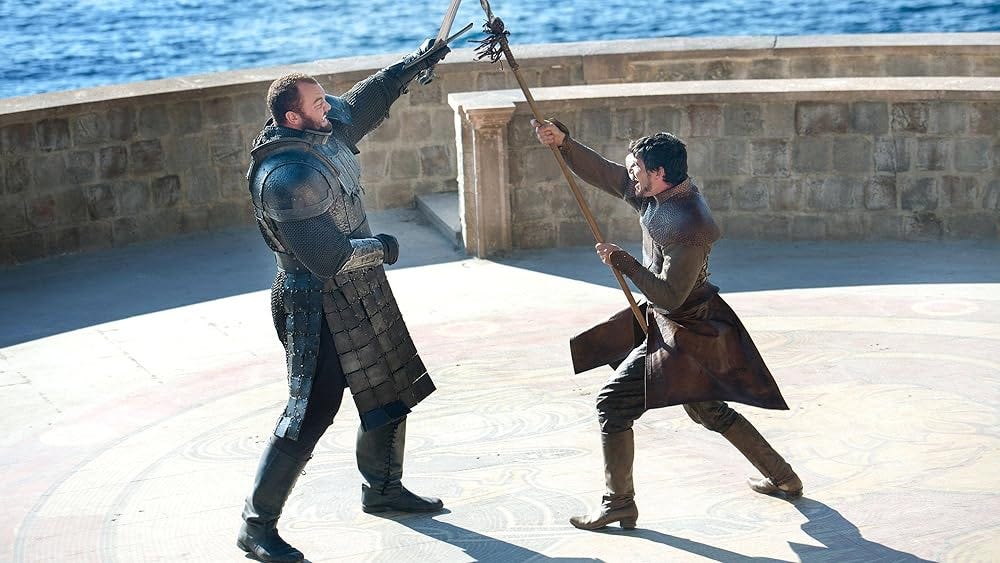
I could be wrong, but it is not difficult to imagine that popular interest in judicial duels owes something to George R. R. Martin. From the very first installment of A Song of Ice and Fire, A Game of Thrones(1996), trial by combat reentered the cultural bloodstream. The most famous example in the series features Tyrion Lannister, falsely accused of poisoning his petulant, tyrannical teenage nephew, King Joffrey. Tyrion demands trial by combat. His champion, Prince Oberyn Martell, faces the crown’s monstrous representative, Sir Gregor Clegane, the Mountain.
Oberyn, lightly armored and armed with a spear, outmaneuvers the larger knight and appears on the brink of victory. But arrogance intervenes. As he demands a confession, the wounded Clegane seizes him, gouges out his eyes, and crushes his skull.
After that episode aired in Game of Thrones, more than a few legitimate historians were quick to point out the resemblance to the fate of Guy of Steenvoorde. Martin has long drawn from medieval history, and the parallels are difficult to ignore.
It is at least plausible that this renewed cultural fascination with trial by combat, sparked or accelerated by Martin’s work, helped revive broader interest in historical judicial duels. That interest surely fed into the popularity of The Last Duel. It may even have emboldened a modern litigant to request one. And it gave us the surreal moment in which Giuliani stood before a crowd on January 6, 2021, and declared, “Let’s have trial by combat.”
So perhaps this did become Wet-Brained Westeros after all. But if a 12th-century Flemish trial can echo through a 21st-century television screen, and from there into courtrooms and political rallies, then maybe that is the point. Trial by combat is long dead as law. As story, it remains very much alive.
Note: Thank you for making it to the end! What began as a farcical blog for a depressed, history-loving nerd to mess around with, an escape from the hole I’d dug, has grown into something more. As I’ve said before, this was always meant to be entertaining rather than academic. I’m not doing the deep-dive research that kept me from pursuing a career in history, but the work I put in here is careful, thoughtful, and, yes, work. And while it often doesn’t feel like work because I love it, it still takes time and effort. So if you’ve enjoyed this, please consider tossing a few bucks my way. My goal is to make history both educational and entertaining, the kind of history that first captured my imagination as a kid. Thank you for reading and for coming along on this journey. If you’ve made it this far, just know, I love you.
I'll be thinking of this article if ever Winds comes out and we get to see Cersei's Trial.
AIDAN OF THRONES.