Hare-brained History Volume 74: the Great Famine
A brief history of Ireland, and then the bad stuff

Welcome to the 74th installment of Hare-brained History, a blog in which your intrepid host will treat you with absurdities, follies, mind-fucks, and everything in between from the world of history. Today, we’re inspired by another person, for the first time in a long time. My friend David (generic Irish last name), he of the 500 LinkedIn connections and my authority on all things money, suggested this. And since it’s the month of Lá Fhéile Pádraig, it makes sense. Today, we’re heading to Éire to look at the horrifying An Gorta Mór.
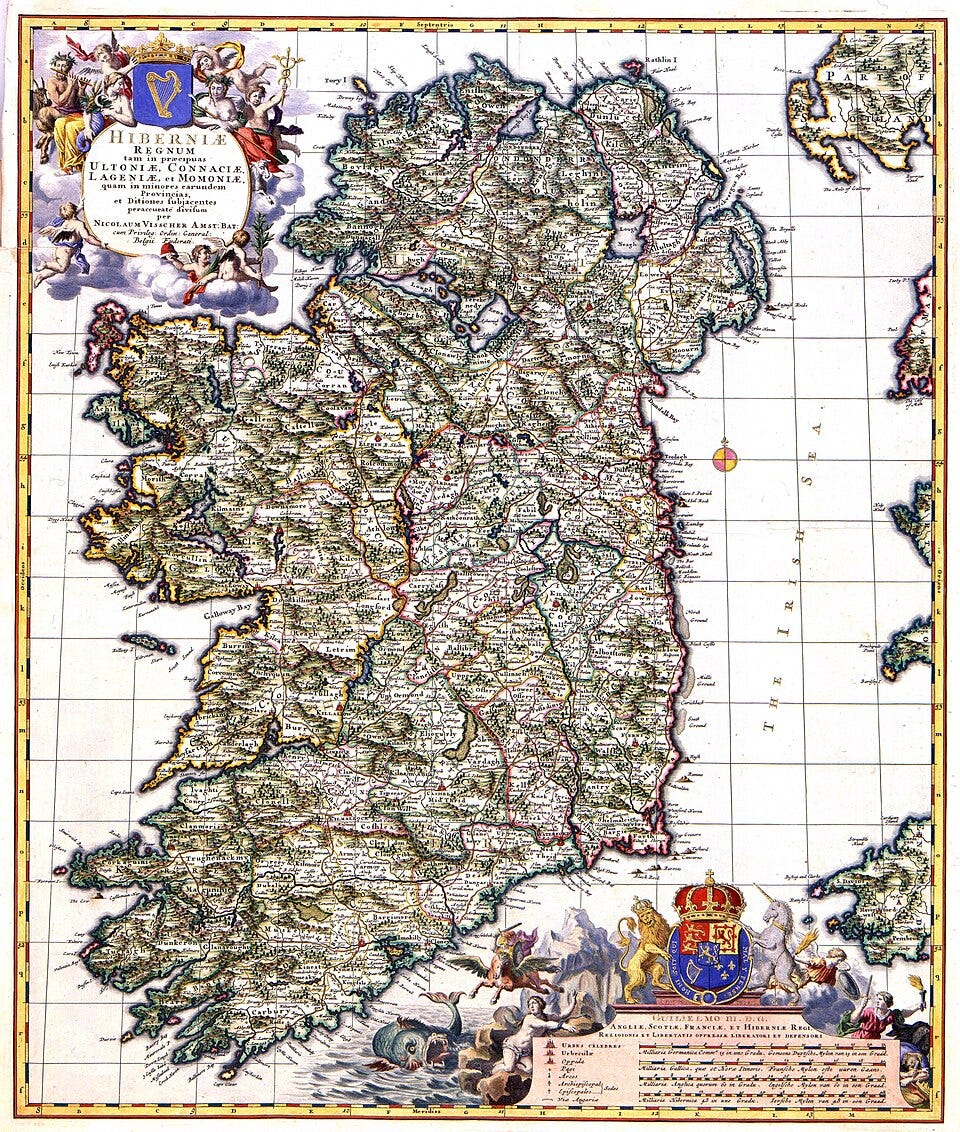
Ireland is, of course, an island, separated from the island of Great Britain by the Irish Sea and the North Channel. Geographically, Ireland is defined by a broad, low central plain, rolling hills, bogs, and river valleys, with mountains and rugged uplands lying mostly to the west and south near the Atlantic coast. Ireland is also, famously, wet. Strongly influenced by the Atlantic Ocean, the island experiences a temperate maritime climate: mild winters, cool summers, and rain. A lot of rain. This combination keeps the land green year-round, earning it the nickname Emerald Isle.
The earliest known inhabitants appear as hunter-gatherers during the Middle Stone Age, sometime around 7900 BC. These people remained hunter-gatherers until about 4000 BC, when agriculture spread and food surpluses allowed for more permanent settlements. Early farming included grains like barley and wheat, but the base soil, geography, and climate made growing a diverse array of crops and large-scale grain cultivation difficult. Grass, however, grows just fine, and so these early peoples turned to grazing livestock, particularly cattle and sheep.
In antiquity, the indigenous Irish population intermingled with Celtic groups who had been pushed westward and into the sea by Roman expansion. Over time, these cultures mixed into the language and culture we recognize as Gaelic by the 5th century AD.
By this time, petty kingdoms had sprung up, with fun names like Mide, Airgialla, Mumhain, and of course Cóiced Ol nEchmacht. These were kingdoms dominated by aristocratic warriors and learned elites, including Druids, a priestly class who served as religious leaders, legal authorities, lorekeepers, and medical professionals. They were reportedly literate, but cultural norms and doctrine prevented them from committing their knowledge to writing. Apparently, anyway, we don’t really know. Most of what we know about them comes from the Romans, biased fuckers that they were.
To the Romans, Ireland was known as Hibernia. There is debate over whether the Romans ever set foot in Ireland, but according to the wonderfully named Turtle Bunbury, “Túathal Techtmar, the son of a deposed high king, is said to have invaded Ireland from afar in order to regain his kingdom at about this time,” perhaps suggesting Roman interference. I thought Turtle Bunbury must have been some early Irish writer from after the coming of Christianity, but no, motherfucker wrote that in 2020.
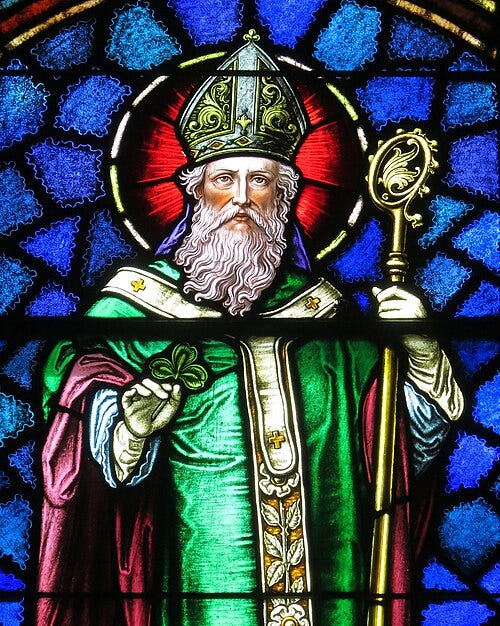
Famously and traditionally, Pádraig is said to have arrived in Ireland and driven the “snakes” out of the island, but that means pagans, dear reader. Saint Patrick is not apocryphal, though the quaint story certainly is. According to Prosper of Aquitaine, the bishop Palladius was sent first, only to be banished by the King of Leinster. Afterwards came Patrick, born in Britain, captured and sold into slavery in Ireland before escaping, later becoming a cleric (according to his own autobiography). He returned to Ireland perhaps as late as 461, working in the more remote kingdoms of Ulster and Connacht. Patrick is traditionally credited with codifying Irish laws and changing those that conflicted with Christian practices.
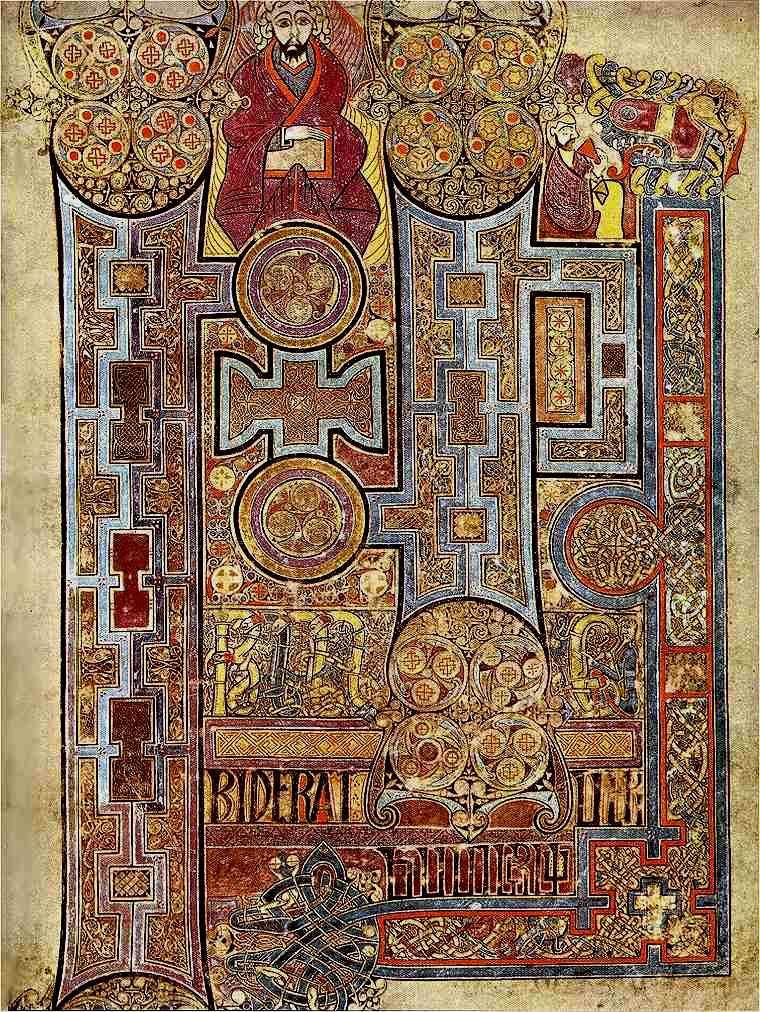
The conversion of the Irish to Christianity was gradual, and at times violent, with many traditional beliefs becoming integrated into, or existing alongside, Christian practice. Irish scholars in monasteries flourished during the early Middle Ages. Beautifully crafted illuminated manuscripts, such as the stunning Book of Kells, were produced, along with flourishing metalwork and sculpted stone crosses across Ireland.
But the good times would not last. Plague devastated the population in Ireland in the late 7th century, and then came the Vikings. Thanks to my Uncle Bob, I have written all about the Viking Age, and so I will quote a great scholar:
“By 853, a Viking leader became the first King of Dublin, establishing a powerful Norse kingdom. Over the next two centuries, Irish kings fought intermittently against Viking dominance on the island. It was not until Máel Sechnaill mac Domnaill, King of Mide, and Brian Bóruma mac Cennétig, mercifully remembered as Brian Boru… eventually became High King of Ireland with Máel Sechnaill’s acknowledgement. He met his end in 1014 at the Battle of Clontarf, where his forces defeated the Dublin Vikings and the treacherous Leinstermen. Brian himself was killed in his tent after the battle…”
At this time, Ireland had a population of fewer than 500,000 people and more than 150 kings. Brian Boru rose steadily through warfare and diplomatic maneuvering to take the title of High King of Ireland, a title that had long existed in name but rarely in practice. He came as close as anyone to creating a unified Irish kingdom. Brian Boru’s dynasty, the Ua Briain, or O’Brien, would dominate Irish politics for decades afterward. Dublin continued to grow, as did Irish trade, castles, and a period of modernization, as Ireland forged commercial and political links with the rulers of France, Spain, and England.
However, Ireland remained divided into petty kingdoms and over-kingdoms. The High King often held power in name only. In the 1160s, when the King of Leinster was forced into exile by the High King, he ran to Aquitaine, the seat of “English” power (even if it was technically in France and ruled by a man born to a French father and Norman mother), and begged King Henry II for permission to recruit the ever war-hungry Normans to help restore him to his kingdom.
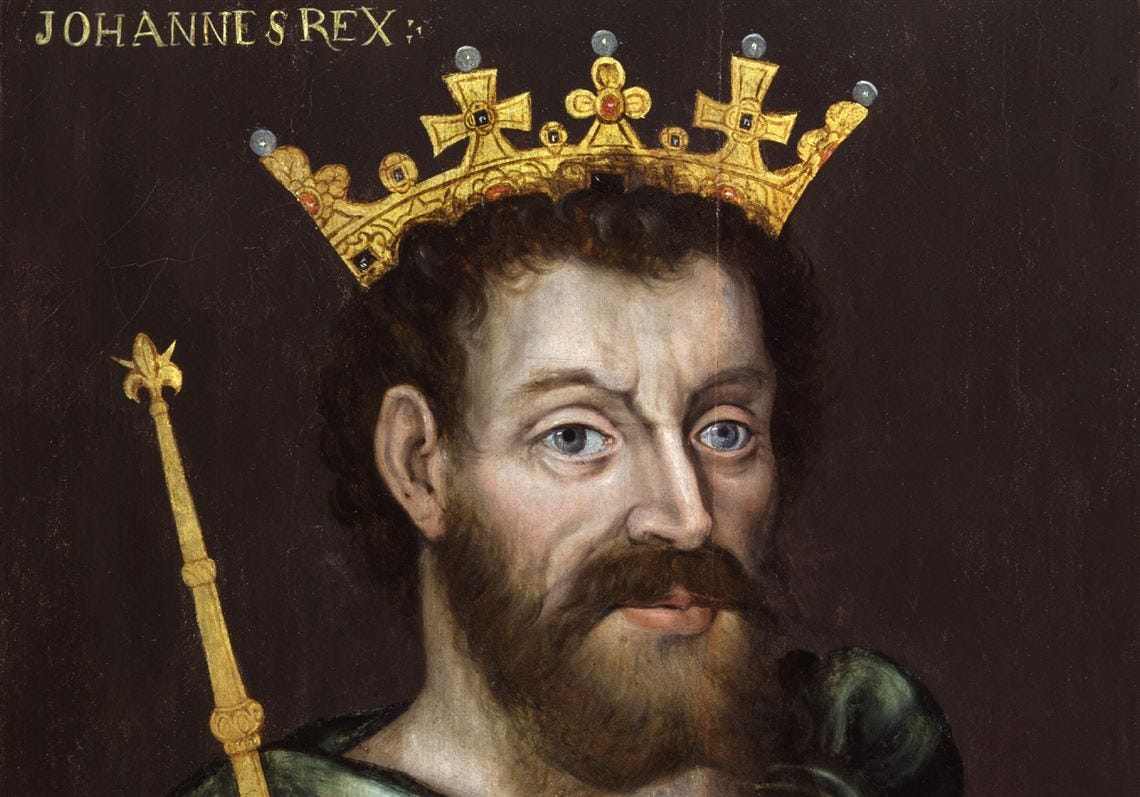
This began the Anglo-Norman invasion of Ireland. Henry II, decisive and ruthless, father of Richard the Lionheart and John of Robin Hood fame, eventually invaded and named John “Lord of Ireland.” When John’s three elder brothers died, he succeeded his brother Richard as King of England, and Ireland thus technically fell under England’s dominion.
Yes, I know this is sweeping a lot together and is all a bit glib. Remember, we’ll eventually be talking about the famine known as the Hard Times, so we must have a bit of fun now. Here is a portrait of King John.
English control in practice was, for a long period, limited to the region around Dublin known as the Pale, while the rest of Ireland remained under the petty Irish kings and Anglo-Norman rulers who had carved out kingdoms of their own. These Anglo-Norman invaders eventually began adopting Irish language, law, and customs, which distressed the English authorities. In response, the Statutes of Kilkenny were enacted in 1366, aiming to prevent cultural assimilation and reinforce English dominance, a dominance which, at this time, largely existed in name only.
Then came Henry VIII. In 1541, somewhere between rotting alive and getting cucked by his soon-to-be decapitated fifth wife, he formally declared the Kingdom of Ireland and sought to bring the entire island under English authority. The Irish did not take this well, and roughly fifty years of conflict and bloodshed began on Erin’s Isle, culminating in the Nine Years’ War, so named because it lasted nine years. When the rebellion was defeated, many of the remaining Gaelic nobles fled to continental Europe. The old Gaelic order was effectively dead, and in the early seventeenth century, the English crown set about establishing firm dominance.
They did this through plantations: lands confiscated from those same nobles were redistributed to English and Scottish Protestants. The most prominent and successful of these was the Plantation of Ulster in northern Ireland (hmm, wonder if that will be important someday). These settlers formed the new ruling class. Several laws were passed attempting to force the Irish to convert to the Anglican Church, while Irish Catholics were increasingly subordinated.
The Irish revolted in 1641, and for several years, the Catholic nobles who remained ruled Confederate Ireland while England was consumed by its own religious and parliamentary civil war. But the victorious parliamentarians under Lord Protector (dictator) Oliver Cromwell invaded Ireland to reassert English authority in a brutal campaign. By its close, 15-25% of Ireland’s prewar population had been killed, displaced, or exiled into indentured servitude in the Caribbean. The process of subjugation and Protestant domination only intensified, and many Irish were forcibly relocated from Ulster to Connacht.
By this time, the English had begun fully dehumanizing the Irish as “savages” and “undesirables.” It would come to full expression centuries later, but anti-Irish prejudice, which already existed, would develop into a racialization of the Irish as not quite white and inherently backward. Famously, in my neck of the woods, signs reading Help Wanted: Irish Need Not Apply and No Irish, No Blacks, No Dogs would appear around Boston.
English control was further cemented after the Glorious Revolution, when the incoming Protestant monarchs of England overthrew the Catholic King James II. James found support among Irish Catholics, who rose with him, but they were ultimately defeated at the Battle of the Boyne.
Discriminatory laws known as the Penal Laws limited the rights of anyone who did not convert to the Anglican Church. Catholics were barred from holding political office, owning certain lands, or receiving higher education. While the well-off often converted to avoid these penalties, the vast majority of the population remained very poor Catholics, focused primarily on feeding themselves.
Despite this, a growing Catholic cultural awakening began to take shape, inspired in part by the revolutions in America and France. The Society of United Irishmen attempted to unite Irishmen of all religions in opposition to British control. Their movement culminated in the Irish Rebellion of 1798, which received support from the French Republic but was brutally suppressed by the British, by then the most powerful nation in the world. Somewhere between 10,000 and 50,000 Irish were killed. In the aftermath, the British government passed the Act of Union in 1800, which dissolved the Irish Parliament and created the United Kingdom of Great Britain and Ireland.
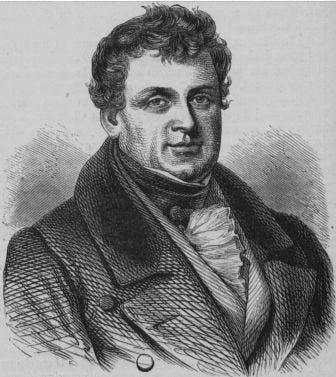
Things would improve slightly in the early nineteenth century thanks to the campaigning of men like Daniel O’Connell, who organized mass political mobilization to peacefully pressure the government. The Roman Catholic Relief Act, commonly known as Catholic Emancipation, repealed many discriminatory anti-Catholic laws in 1829. Executive power over Ireland lay with the Lord Lieutenant and Chief Secretary, appointed by the British, while 105 and 28 Irishmen were elected to sit in Parliament, respectively in the House of Commons and Lords, the vast majority of them protestant landowners. But despite these reforms, stark inequalities remained. Daniel O’Connell.
By the mid-1840s, the population of Ireland had swollen to more than eight million people, making it one of the most densely populated places in the world. Most of these people were impoverished Catholics working as tenant farmers, cultivating small plots of land owned by landlords, many of whom lived in Britain. Some were English outright, while others were what the Irish derisively called “West Britons,” countrymen who had gone along with British rule, intermarried, and become part of the Anglo-Irish landlord class.
This system bore similarities to the Russian system of serfdom. Rent collection was managed by landlord agents or middlemen who leased large tracts of land on long-term, fixed-rate agreements and then sublet them to tenants. These middlemen often harshly exploited the farmers beneath them and could evict them at will for nonpayment of rent, or simply if the middleman or landlord decided to use the land for a different purpose.
By 1843, the British government recognized that the land system was a foundational cause of disaffection in Ireland, and at the request of Sir Robert Peel, the Conservative prime minister, a royal commission was established to investigate land laws and the conditions faced by tenants. As Daniel O’Connell accurately described it, the commission, made up largely of wealthy landlords, was “perfectly one-sided.” Even so, the body, chaired by the Earl of Devon, reported stark findings:
“It would be impossible adequately to describe the privations which they habitually and silently endure…expressing our strong sense of the patient endurance which the labouring classes have exhibited under sufferings greater, we believe, than the people of any other country in Europe have to sustain.”
The commission found that conditions were somewhat better only in Ulster, where tenant rights were more established. Still, the body was merely fact-finding; little immediate reform followed.
Poor tenant farmers toiling in Ireland’s difficult soil and climate relied heavily on a single crop for both sustenance and survival: the potato. Their holdings were so small that no other crop had the yield potential to both feed their families and pay rent. As a result, the potato became the staple of the Irish diet. The most common variety was the Irish Lumper, a white potato known for its ability to grow in poor, nutrient-depleted soil or extremely wet ground.
The conditions were brutal. As the Devon Commission found, for the majority of Irish people:
“In many districts their only food is the potato, their only beverage water…their cabins are seldom a protection against the weather…a bed or a blanket is a rare luxury…and nearly in all their pig and a manure heap constitute their only property.”
This system, tenant farming dependent on a single crop, was extremely fragile. That fragility was laid bare when, in 1845, Phytophthora infestans arrived. Commonly known as potato blight, it is an oomycete, a parasitic organism related to brown algae, not a fungus. The disease appears first as small, dark, water-soaked spots on potato leaves that expand into brown, greasy-looking lesions. Stems may darken and collapse, while infected tubers develop brownish-purple patches and reddish-brown rot beneath the skin. The organism thrives in cool, humid weather and produces windborne spores that germinate on wet surfaces.
While we are unsure exactly when or how the blight arrived in Ireland, we know it originated in the Toluca Valley of Mexico and had reportedly caused crop failures in the United States before 1844. It may have crossed the Atlantic on potatoes used to feed passengers on ships, later spreading spores to Ireland’s fields.
On August 16, 1845, the Gardeners’ Chronicle reported that “a blight of unusual character” had appeared on the Isle of Wight. Less than a month later, on September 13, the paper announced:
“We stop the Press with very great regret to announce that the potato Murrain has unequivocally declared itself in Ireland.”An Irish Peasant Family Discovering the Blight of their Store by Daniel MacDonald
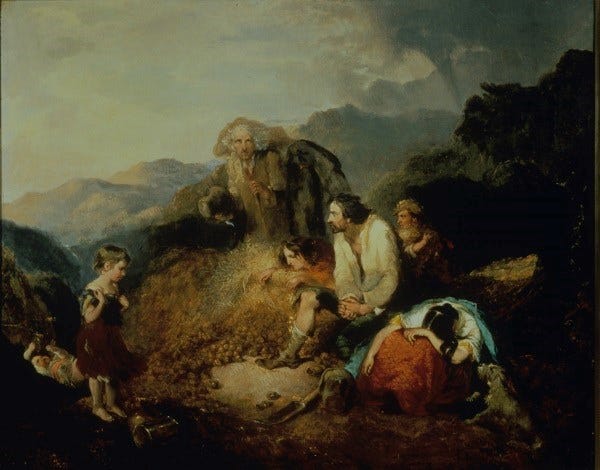
Peel’s government remained cautiously optimistic through September as it received conflicting reports about the scale of the blight. But when the potato crop was finally harvested in October, the truth became clear: somewhere between one-third and one-half of the crop had been lost. Even then, Peel wrote to the Home Secretary that while the loss was serious, there was “always a tendency to exaggeration in Irish news.”
A deputation of prominent Irish figures, including Daniel O’Connell, approached the Lord Lieutenant of Ireland with proposals to address the crisis. They suggested opening the ports to foreign grain, halting the distillation of grain into alcohol, prohibiting the export of foodstuffs, and providing employment through public works. All sensible and practical suggestions. But Lord Heytesbury, the Lord Lieutenant, dismissed their concerns, telling them their alarm was “premature,” and assuring them that Britain’s best and brightest nineteenth-century scientists were already working on a solution.
The early blight was bad, and people suffered, but the response of Peel’s government, characterized by Irish historian F. S. L. Lyons as “prompt and relatively successful,” did attempt relief measures. Peel secretly purchased large quantities of maize and cornmeal from the United States, careful not to “stifle private enterprise” or disrupt local and charity efforts. Unfortunately, the shipments did not arrive until February 1846, and neither maize nor cornmeal proved especially popular. The unfamiliar yellow meal required long cooking, and the poor referred to it derisively as “Peel’s Brimstone.” Still, it was something.
Peel also moved to repeal the Corn Laws, tariffs on imported grain that kept bread prices artificially high. This decision split his Conservative Party, forcing him to resign in December 1845. Yet the opposition Whigs failed to form a government, and Peel was soon reappointed. He initiated public works programs to provide employment and wages to the starving population, but by then, the situation had deteriorated. Even the eventual repeal of the Corn Laws did little to immediately alleviate the crisis.
Hoping to control the growing unrest in Ireland, Peel proposed a Coercion Act that would grant Parliament expanded powers to suppress disorder. The measure was defeated, and Peel resigned again in March 1846. The Whig leader, Lord John Russell, took power and would preside over the worst years of what the Irish contemporaneously called an Droċ-Ṡaoġal, loosely, “the hard-time.”
In 1846, the catastrophe deepened. Three-quarters of the potato crop was destroyed by blight, and the first deaths from starvation were recorded. Around three million people were completely dependent on the potato, with millions more relying on it for a large portion of their diet. Many had already gone hungry; now they were beginning to die.
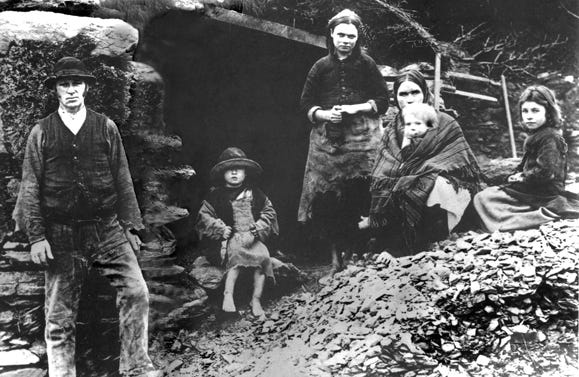
Daily life became a desperate search for anything edible. Many abandoned attempts at farming altogether and instead gathered whatever they could find, wild plants, seaweed, nettles, turnips, alongside the government distributions of maize and cornmeal. Malnutrition affected everyone, though children and the elderly suffered first. Even strong adults soon showed the physical signs of starvation: swollen bellies, gaunt faces, hollow eyes, and crushing fatigue. People often went days without eating anything.
As so often happens in famines, disease followed close behind. Typhus, cholera, and dysentery swept through towns, cities, and overcrowded workhouses, killing as many, if not more, than starvation itself. The dead were buried in mass graves or hastily covered pits; there were simply too many bodies for proper funerals.
The artist James Mahoney, living in Cork, was asked by the Illustrated London News to travel the countryside and report on conditions in early 1847. What he saw was horrifying. He wrote:
“Here, for the first time, the horrors of the poverty became visible, in the vast number of famished poor who flocked around the coach to beg alms. Amongst them was a woman carrying in her arms the corpse of a fine child, making the most distressing appeal to the passengers for aid to enable her to purchase a coffin and bury her dear little baby… each step that we took westward brought fresh evidence of the truth of the reports of the misery, as we either met a funeral or a coffin at every hundred yards…
To Bridgetown, and there I saw the dying, the living, and the dead lying indiscriminately upon the same floor, without anything between them and the cold earth save a few miserable rags… not a single house out of 500 could boast of being free from death and fever. Several had the dead lying close to the living for three or four, even six days, without any effort being made to remove the bodies.
From three to five hundred women, with money in their hands, were seeking to buy food, whilst a few of the Government officers doled out Indian meal to them in their turn. One woman told me she had been standing there since daybreak seeking to get food for her family at home…
This food…was being doled out in miserable quantities, at ‘famine prices,’ to the neighbouring poor from a stock lately arrived in a sloop, with a Government steamship to protect its cargo of 50 tons; whilst the population amounts to 27,000; so that you may calculate what were the feelings of the disappointed mass…”
For millions of Irish people, this was daily life during the famine: hunger, disease, exhaustion, and the slow collapse of entire communities.
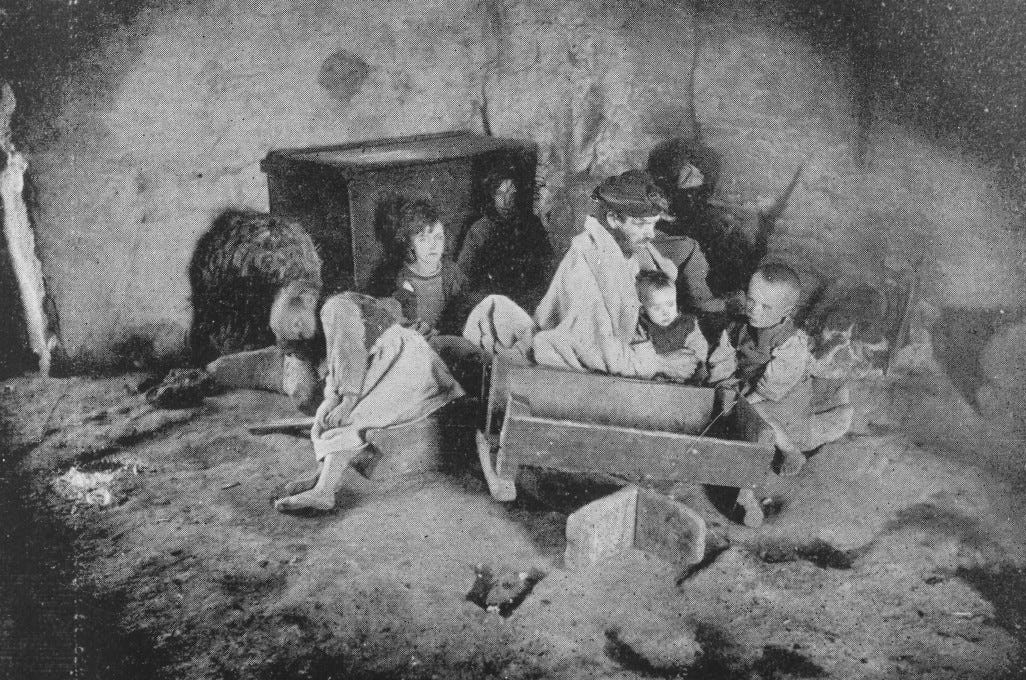
The response to the famine abysmally failed the Irish people. Evictions became another grim and defining feature of the crisis. It is impossible to know exactly how many people were driven from their homes, but after 1849, when police began formally recording the numbers, some 250,000 people were officially evicted between 1849 and 1854. This is almost certainly a significant underestimate.
Landlords removed tenants who could not pay. Under the Poor Law system, landlords were responsible for paying the rates of any tenant whose yearly rent was £4 or less. Estates crowded with poorer tenants therefore faced rising financial burdens, and many landlords responded by clearing these tenants from their plots and consolidating land into larger farms renting for more than £4, which reduced the amount they themselves had to pay. Entire villages were sometimes cleared, their homes demolished so the tenants could not return. Homeless families wandered the countryside and crowded into already-strained towns and cities.
For some landlords, this was a harsh but practical business decision. Others behaved with extraordinary cruelty, particularly those whose own wealth and lifestyle were not seriously threatened. The Mahon family of Strokestown Park House evicted more than 3,000 people in 1847 while continuing their comfortable lifestyle, dining on lobster soup and drinking brandy. Henry John Temple, 3rd Viscount Palmerston, an Anglo-Irish landowner, evicted roughly 2,000 tenants from his estates. George Bingham, 3rd Earl of Lucan, owner of more than 60,000 acres, was among the most notorious evicting landlords. He justified his actions by declaring he “would not breed paupers to pay priests.”
The young Bishop of Meath, Thomas Nulty, described witnessing one such eviction:
“Seven hundred human beings were driven from their homes in one day and set adrift on the world… The horrid scenes I then witnessed I must remember all my life long. The wailing of women—the screams, the terror, the consternation of children—the speechless agony of honest industrious men—wrung tears of grief from all who saw them… I saw officers and men of a large police force… cry like children at beholding the cruel sufferings of the very people whom they would be obliged to butcher had they offered the least resistance… and in little more than three years nearly a fourth of them lay quietly in their graves.”
Some people, enraged and desperate, took matters into their own hands. In 1847 alone, seven landlords were shot, six of them fatally. These acts of violence briefly shifted British opinion away from sympathy for the starving Irish and toward renewed condemnation of what commentators portrayed as Irish backwardness and lawlessness.
In response, Parliament passed the Crime and Outrage Act in December 1847. The law restricted gun ownership and forced local men, under threat of punishment, to join posses to hunt suspects. Additional troops were sent to Ireland.
As these measures suggest, the suffering of the Irish poor was not at the forefront of the Whig government’s priorities. Influenced by laissez-faire economic ideology, the Whigs believed it was not the government’s role to intervene heavily in the market. They assumed that market forces would eventually supply the food and employment the Irish needed. As a result, many of the relief efforts begun under Prime Minister Peel were halted, leaving hundreds of thousands, along with those who depended on them, without access to work or food.
When the resulting devastation became undeniable, the government introduced public works programs. These proved extremely difficult to administer and often ineffective. Charles Trevelyan, who oversaw the food relief program, limited its scope, arguing that once people earned wages through work, the market would supply food through imports. Privately, he wrote to the Poor Law Commissioner:
“We must not complain of what we really want to obtain. If small farmers go, and their landlords are reduced to sell portions of their estates to persons who will invest capital we shall at last arrive at something like a satisfactory settlement of the country.”
In other words, the collapse of the small farming class and the death or emigration of many poor Irish might be acceptable if it ultimately produced a more efficient agricultural system. So you know, fuck him.
By January 1847, the crisis had grown so severe that the government abandoned some of its earlier policies and, through the Irish Poor Law, expanded relief efforts. Workhouses were established but quickly became dangerously overcrowded, filled with waste, disease, and starvation. Soup kitchens were also opened, though the food often amounted to little more than thin broth. Some were run by the Anglican Church and became infamous for offering food only to those willing to renounce Catholicism.
Even accessing this limited relief could be deadly. Many starving people had to travel long distances in their weakened condition to receive aid, and often arrived only to be turned away. One of the most infamous incidents occurred on March 30, 1849. Two Poor Law commissioners arrived in an area to inspect those receiving relief, but instead went to stay at a nearby hunting lodge. Desperate residents walked roughly 12 miles (19 kilometers) to reach them, far farther than they would have needed to travel had the officials remained where they were supposed to be. When they arrived, they were told they would receive no relief and were ordered to go home. At least seven died afterward, though the number may have been closer to twenty.
The cost of the Poor Law system fell largely on landlords, which encouraged further evictions as they attempted to reduce their financial liability. In time, Trevelyan’s vision of agricultural restructuring did come to pass: much of the land was eventually purchased cheaply by English speculators and converted into large cattle-grazing estates.
On March 1, 1847, the Bank of England announced it would raise a £14 million loan both to address the Irish crisis and fund tax cuts. The financial maneuver backfired, contributing to the Panic of 1847. Gold was withdrawn from circulation, limiting the amount of banknotes that could legally be issued. By April, the Bank’s reserves had fallen by £6 million. Ultimately, the cost of famine relief was largely borne by local taxation in Ireland, a move that helped stabilize the British financial system but did little to alleviate the suffering of the starving Irish.
Public opinion in Britain was sympathetic, though frequently patronizing and reluctant to support large-scale intervention. The prevailing attitude was summarized by The Times on March 24, 1847, which acknowledged that Britain had created:
“a mass of poverty, disaffection, and degradation without a parallel in the world. It allowed proprietors to suck the very life-blood of that wretched race.”
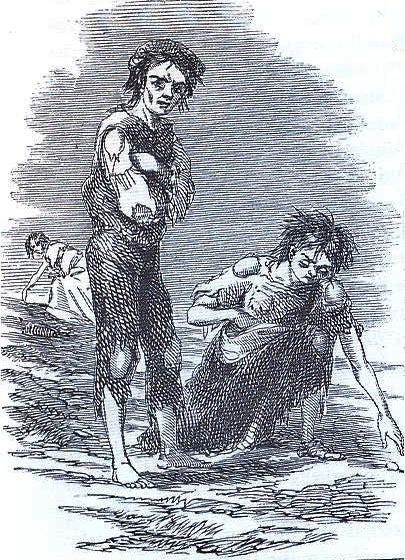
Scene at Skibbereen during the Great Famine, The Illustrated London News, 1847
Just because the government failed, or succeeded, depending on your perspective (we’ll get there), doesn’t mean people everywhere failed the Irish. People of Irish descent abroad and wealthy Irish donors raised vast sums, and English Protestants outside Ireland actually donated more to famine relief than any other group.
Some of the earliest international campaigns were led by the Boston Repeal Association and the Catholic Church. One of the first major foreign donations came from Calcutta, though it should be noted that much of that money came from Irish of the East India Company. Queen Victoria, then in her early thirties, donated £2,000 (about £244,000 today, you can look up what that is in dollars). Speaking of dollars, the American president, asshole James K. Polk, donated $50 (about $1,700 today, believe it or not), while freshman congressman Abraham Lincoln contributed $10. The Lincolns, after all, were never well off. According to legend, the young Sultan Abdülmecid I planned to send £10,000 in aid, but British diplomats convinced him to reduce the donation to £1,000 so as not to outdo the Queen.
In the United States, especially, immense charitable contributions were made, more than from any other nation aside from Great Britain itself. For once, Americans managed to set aside religious, racial, and political differences and sent 118 vessels carrying relief goods valued at $545,145 to Ireland, in addition to financial contributions. Perhaps most famously, the Choctaw Nation, only sixteen years removed from their own forced displacement and starvation during the Trail of Tears, sent money to aid the Irish. That act of solidarity is honored today with the Kindred Spirits sculpture in County Cork.
Not that any of this, as heartwarming as it can be, was enough to ease the immense suffering. Beyond the staggering death toll and physical misery, the famine shattered the social fabric of Ireland, particularly in rural areas. Entire communities collapsed. The Irish language declined sharply, in part because the regions hardest hit by famine were also those where Irish-speaking populations were strongest.
Emigration became one of the few avenues of escape. Exact numbers are difficult to pin down, but roughly two million people left Ireland during the famine. In some counties, depending on the year, between 45 and 85 percent of the population emigrated.
The famine was not the sole cause; Irish emigration had already begun in earnest, but it accelerated the process into something closer to a mass exodus. Families rarely emigrated together, as most simply could not afford it. Instead, younger family members often went first, hoping to find work abroad and send money home.
Even reaching a vessel did not guarantee safety. Many emigrants traveled on overcrowded, poorly maintained ships rife with disease. Mortality rates were so high that these vessels became known as “coffin ships.” Those who survived often arrived destitute in unfamiliar lands that, sympathetic from afar, could become suspicious and hostile up close. The old anti-Irish stereotypes quickly resurfaced.
Most emigrants settled wherever they landed. The cities that received the largest numbers included Liverpool, Great Britain; Toronto, Canada; and Boston, New York, and Philadelphia in the United States. All of these places retain strong Irish cultural influences today. Where I grew up, the region is even known as the “Irish Riviera,” with one of the highest percentages of people (happily) claiming Irish descent in the country and the world. But that is today. At the time, the sudden influx of Irish immigrants, viewed as a population not quite white, brought violence, abuse, and prejudice upon the new arrivals.
Ireland’s population fell dramatically during the famine. It dropped from more than 8 million in 1841 (officially 8.175 million, though even that is likely an underestimate) to about 6.5 million in 1851. The decline did not stop there. For more than a century afterward, Ireland’s population continued to decline due to emigration and demographic change. Only in relatively recent decades has it begun to grow again, and it still remains far below its pre-famine peak.
How many people died? It is impossible to say with certainty. Historians continue to debate the number, but it is almost certainly more than one million deaths caused directly by famine and the diseases that accompanied it.
During the great Year of Revolutions in 1848, the Young Ireland movement, having broken from the more moderate politics of Daniel O’Connell, briefly attempted an uprising. On June 29, 1848, they engaged in a short gunfight with constabularies before the movement was suppressed. While it is often called a rebellion, that description is generous.
The Great Famine did not end suddenly, nor did it end because of decisive government intervention. Gradually, the blight became less severe, farmers began planting different crops, and the increasing return to pasture, something Ireland’s land is better suited for, helped stabilize food production. Frankly, however, the largest reason the famine ended was that the population had been reduced so drastically that pressure on land and food supplies eased.
By 1852, the worst of the famine was over, but its consequences endured for generations. Rural society and Irish culture were irreversibly changed, and large-scale emigration became a permanent feature of Irish life as land was increasingly consolidated and used for pasture. A 2025 study found that the long-term health of survivors was not as stunted as might be expected, largely because excess mortality and migration removed many of the most vulnerable from the population. In simple terms, the young either died or left.
The average age of the population rose, as did the age of marriage. Many who remained never married at all, perhaps as many as a third of men and a quarter of women, largely because poverty and economic instability persisted. There were also many orphans, and tragically, many very young women turned to prostitution simply to survive. Things didn’t get better.
The blight returned in 1879, but by then, Irish farmers had begun what became known as the Irish Land War, a period of boycotts and agitation by rural farmers and laborers against the harsh conditions they continued to face. That struggle would last for decades and belongs to another edition. The famine of 1879 was both shorter and less severe for several reasons.
As for the Great Famine itself, surprisingly, for a country renowned for its rich folk tradition, the event is largely absent from much of Ireland’s musical and storytelling heritage, likely because of the immense pain it caused. It is not entirely absent, however. The song Skibbereen tells of a father explaining to his son how famine, eviction, and the aftermath of the Young Ireland rebellion forced them to flee their homeland.
The question of whether the famine constituted genocide remains controversial. Most historians reject that claim, and I am inclined to agree. For a mass-death atrocity to be defined as genocide, it must involve the intentional destruction of a people, and the British response was more accurately characterized as apathetic and disastrously inadequate. The suffering of the Irish was, for some, the worst of the worst, economically convenient, reducing population pressure and facilitating land consolidation, but that was not the explicit goal of policy, nor was it the prevailing attitude of the British people or even the government.
Irish historian Cormac Ó Gráda summarized the academic consensus bluntly: “No academic historian continues to take the claim of ‘genocide’ seriously.” Genocide requires murderous intent, and even the most prejudiced commentators of the time did not openly advocate the extermination of the Irish.
In the United States, the famine has occasionally become part of political and educational debates. The state of New Jersey, for example, incorporated the Great Famine into high-school curricula after lobbying by Irish-American organizations, sometimes alongside topics like the Holocaust and slavery. To say the issue is contentious would be an understatement.
Historian Donald Akenson warned against turning the famine into what he called “famine-porn,” writing that when such comparisons appear, they are usually driven more by emotion or political agenda than careful scholarship.
In the end, the British government failed. It effectively admitted as much in 1997, roughly 150 years too late. The catastrophe was the culmination of generations of neglect, misrule, colonial policy, and economic vulnerability. Yet endless arguments over terminology can obscure the real story.
The Great Famine is ultimately about human suffering. Politics, race, religion, and empire were all part of it, but the core lesson lies in what happens when ideology, indifference, and power collide with human vulnerability. When those lessons are ignored, history has an unfortunate habit of repeating itself.
Note: Thank you for making it to the end! What began as a farcical blog for a depressed, history-loving nerd to mess around with, an escape from the hole I’d dug, has grown into something more. As I’ve said before, this was always meant to be entertaining rather than academic. I’m not doing the deep-dive research that kept me from pursuing a career in history, but the work I put in here is careful, thoughtful, and, yes, work. And while it often doesn’t feel like work because I love it, it still takes time and effort. So if you’ve enjoyed this, please consider tossing a few bucks my way. My goal is to make history both educational and entertaining, the kind of history that first captured my imagination as a kid. Thank you for reading and for coming along on this journey. If you’ve made it this far, just know, I love you.
Thorough piece Aiden, props to the breadth of coverage in all things related to it❤️🩹🎙️🕊️
Very insightful and one of the most professionally written volumes I've read from you. Another good read!