The Cell
For those who have been dragged there

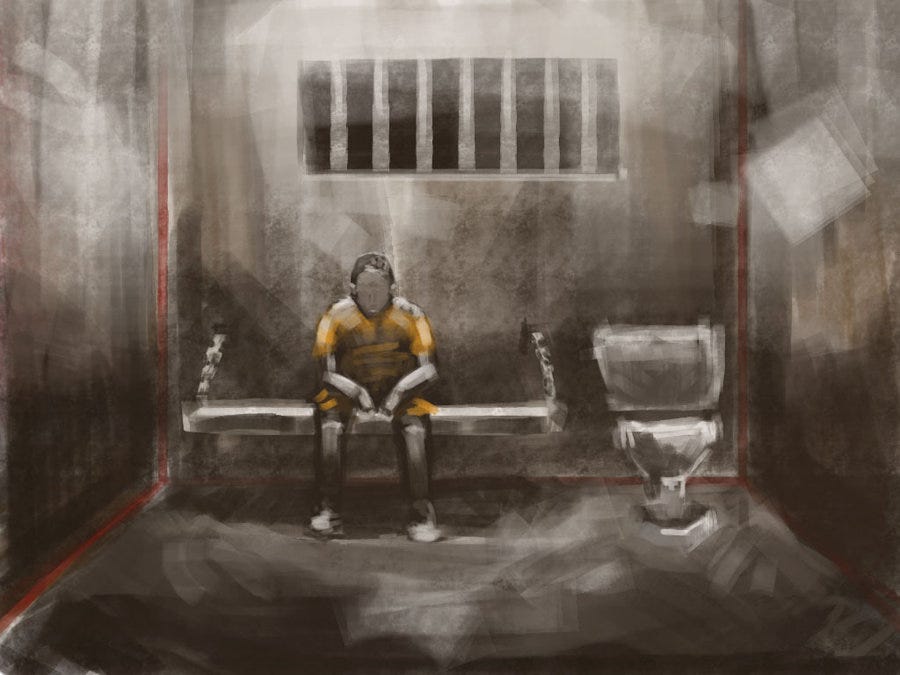
The shadow I carry is as heavy as the chains of Marley’s Ghost, each link forged from old failures and familiar lies. Most days, I can bear its weight. Other days, it grows too heavy, dragging me back down into the cell I thought I’d escaped. As I sink, the square of light above grows smaller. Color bleeds from the world. Sound dulls. Everything is reduced to the same endless gray.
The walls are waiting for me. They are covered in the graffiti of an inmate who has lived here for years, words carved so deeply they seem part of the stone itself.
“You are worthless.”
“You are a burden.”
“Nothing will ever change.”
Between those sentences are the desperate claw marks from every previous escape attempt. Grooves gouged so deeply my fingertips still seem to fit inside them. I had climbed before. I had fought my way toward the light until I could almost feel its warmth on my face. I can still see the nail marks disappearing upward into the darkness above me, proof that I almost made it.
Then I fell. The impact never really ended. It reverberates in my bones, in the fractures that never healed quite straight. Looking up, the distance seems impossible now. The opening is still there, but it feels farther away than I remember, shrinking each time I stare at it. I don’t know whether I have the strength to climb again, or whether I’ll lose my grip and tumble back into the same familiar darkness.
The cruelest part is that this prison has no bars. Its walls are transparent. I can see life continuing beyond them. I watch people laugh, love, and move forward while I remain trapped just inches away, separated by something no one else can see. To them, there is no cell. To me, there is nothing else.
The walls tint everything they touch the color of ash until hope itself looks gray, and I am left wondering whether I built this prison, or whether I have lived inside it for so long that I no longer remember the difference.
Author’s Note
This is for everyone who has found themselves dragged back into the cell. You can climb out. You have before, and you will again.
But not every story or prose about depression needs to end with escape. Sometimes the most honest thing a piece of writing can do is bear witness. Sometimes the struggle needs to be seen. Sometimes the cell itself needs to be seen, so that the people trapped inside it know they are not alone.
The image of the ghosts rattling chain is powerful and physically effective, and the metaphor of the cell with scrawled messages from the prisoner on it, further trapping him, is a brilliant device to explain how depression works to traps in the walls of our own mind.
As you say, not everything needs to be uplifting, sometimes finishing with truth is enough. And certainly more accurate reflection to someone struggling who might read this.
💜