The Odyssey: A Mythological Analysis
Also a film review, but like there are so many of those. How else am I going to entice you?


AL: I am currently walking out of the theater, riding down an escalator, listening to some neckbeard in front of me complain about a movie I have been waiting my whole life for. A movie that somehow lived up to the immense weight of that expectation.
So much of the experience of watching this film is dictated by the medium on which you see it. The visuals, the sound, the score, they’re all amplified. This is a movie best experienced the way Director Christopher Nolan intended: on the rapidly disappearing 70mm IMAX format. In the United States, there are currently only 25 theaters capable of projecting the film this way, and 32 percent of them are in California. Because of that, you probably won’t be able to see it as intended, and that’s okay.
So my cinephile buddy, Aidan (not me), and I schlepped down to our great state’s diminutive neighbor to visit another dying breed: the shopping mall. At the utterly massive Providence Place, surrounded by the peculiar species of people who hang around malls at 9 o’clock on a Thursday night, we shuffled into the Apple Providence Place Cinemas. Popcorn littered the floors, the seats were satisfyingly sticky, and we first had to endure the uniquely painful cringe of a movie pre-show. We watched the same Rhode Island anti-vaping ad about six times, followed by a five-minute preview of Dune: Part 3. Aidan was excited. I wasn’t.
Julia, what was your film-watching experience?
JG:
No IMAX near me, can you believe that? (AL: I can) But nothing could’ve stopped me. So I got there too early, sat down with a knot in my stomach, binged half of the popcorn before the trailers had even started. Next to me, my little sister: absolutely clueless about what she was going to see, excited just the same. It got me thinking, quite the time we’re living in, where a 3,000-year-old epic, literature’s foundational myth, is trending. Not just on my TikTok, on bestseller charts too, or so I read.
But that’s Nolan at his best.
And so is this movie, a stunning feat in itself. Then again, Nolan’s eye for the grandiose suits the story and its setting. Despite my few complaints below, I do think he’s a great director, and probably the right choice for this adaptation... Probably (because I’m feeling nice) [AL: She isn’t], and not without error.
Either way, it felt like feasting on ambrosia from the start, didn’t it?
AL: Like Ambrosia, Matt Damon immediately faced the Sophie’s Choice of remaining forever with Charlize Theron or returning home to Anne Hathaway.
The horror.
“Least expected part of the movie: first line going to Travis Scott,” as my friend pointed out afterward. The Astroworld (RIP) rapper does exactly what is required of him in the role, which is very little.
Now, why did this movie mean so much to me? Well, I have loved Greek mythology my entire life. I don’t remember when I received my first book on Greek myth, only that I was far too young. I’ve been waiting my whole life for a truly great adaptation of a Greek myth. Hollywood has always struggled with Ancient Greek mythology, and understandably so.
It is a world where magic, fate, divine interference, and a distinct lack of free will govern nearly everything. Those are fascinating ingredients for mythology, but difficult ones for cinematic storytelling.
Adapting gods to the screen is notoriously difficult. You either embrace the glorious absurdity, as Clash of the Titans does, or you swing hard in the opposite direction, as Troy (2004) did, portraying the Trojan War as a grounded historical conflict. That’s a shame, because it really would have been entertaining to watch Orlando Bloom’s Paris judge a beauty contest between three naked goddesses, inadvertently starting the greatest war in Greek legend.
In Troy, the wonderful Sean Bean (RIP Ned) plays Odysseus. Matt Damon is excellent here, but anyone who has read Homer will immediately recognize that Bean’s Odysseus is actually much closer to the man described in Homer’s Odyssey: a snarky, self-important asshole blessed with extraordinary intelligence. Damon’s Odysseus, by contrast, is far more sympathetic and humble, qualities that are almost the antithesis of Homer’s version, and deeply regretful of the role he played in ending the Trojan War through the Trojan Horse. In fact, Odysseus’ shame over the deception is one of Nolan’s biggest departures from the source material. Homer’s Odysseus, if asked about the Trojan Horse, would have responded with something approximating: “Ahah. I fucking did that.”
Adapting The Odyssey is extraordinarily difficult for several reasons. It is a sprawling tale spanning twenty years, imbued with fantastical magic, and its protagonist is, frankly, an asshole. There is a reason it has been adapted so few times, and why most adaptations are loose reinterpretations, like the Coen Brothers’ O Brother, Where Art Thou?
Nolan walks a remarkably difficult line. He embraces the magic of Ancient Greece, Polyphemus the giant Cyclops, Circe the witch, and Odysseus’ divine patron, Athena, Goddess of Wisdom, who spends much of the story desperately trying to keep her favorite mortal from getting himself killed. Somehow, Nolan adapts all of them without stripping away the fantasy or making them feel out of place. [JG: Agreed.]
The Cyclops sequence is shot like a horror film, while Samantha Morton’s wonderfully deranged Circe brings genuine body horror as she transforms Odysseus’ crew into pigs. Zendaya’s Athena, despite literally being a goddess, feels strangely believable. She imbues Athena with a quiet sadness and ancient wisdom that feels faithful to Homer, as does the fact that almost none of her advice manages to penetrate Odysseus’ (or the audience’s) thick skull(s).
Now, this is far from a completely faithful adaptation. Entire books of The Odyssey and numerous characters are omitted, but that’s okay. Homer’s epic is famous because it is influential, not because it is perfectly paced. Believe me. Nolan streamlines the material considerably.
Now, because I find it interesting, and hopefully you do too, what exactly changes?
JG: We can start with the gods and goddesses, and where are they?
Oh, in a clap of thunder.
It’s an interesting decision to leave everyone out except for Athena, whose actual role within the epic is so crucial it probably conflicted with screen time, so they decided to leave that out as well.
Athena, a goddess of WAR, wears a sheer little scarf (!!)[AL: I like her scarf] and pops up here and there with random blurbs that are more redundant than wise (sorry, Z). Nowhere to be found in key moments of the story, to the point that the other gods, in all their ~omnipresence~, feel more powerful than she.
In all fairness, Nolan builds toward the idea of gods and goddesses permeating everyday life. They hide in the subtext of most conversations, driving the movie’s theme of cause and consequence forward.
The difference is that in Homer’s Odyssey, the gods and goddesses are always actively intervening. They would physically show up to pull your hair if needed, and reducing that power to a flat piece of advice or a clap of thunder at the right time felt sort of simplistic.
AL: Mrs. G is right, here we have only Zendaya’s Athena, whereas Homer’s epic features a part of the whole divine bureaucracy. To simplify an extremely intricate and magically imbued world, Nolan had to make a lot of cuts and changes, which ultimately I think was necessary, and he did the best he could under the circumstances. Among several deities cut is, most notably, poor Hermes, the perpetually overworked messenger of the gods, has to show up and convince the nymph Calypso to release her immortal sex toy, Odysseus. I think Zendaya does well in the subdued role, despite the uproar over the casting. Speaking of which.
Much has been made online about Lupita Nyong’o being cast as Helen of Troy, which is both hilarious and depressing. It is Greek mythology. They can look however you want. And honestly, who the fuck cares? Far stranger to me is that Nyong’o plays both Helen, wife of the King of Sparta Menelaus, a very Jon Bernthal-looking Jon Bernthal, and Helen’s sister Clytemnestra, wife (and eventual murderer) of Agamemnon, King of Mycenae, played by an aura-farming Benny Safdie, who looks so intimidating that Nolan wisely delays giving him dialogue for as long as possible.
The odd thing is that, in Greek mythology, Helen and Clytemnestra aren’t even twins. I suspect Nolan was simply trying to get his Lupita Nyong’o’s worth, who, unfortunately, has painfully little to do. Or, as my friend suggested, maybe the budget couldn’t afford another actress. Though if it meant getting to stab Benny Safdie, I’d have done it for free.
One of Nolan’s biggest structural changes concerns Odysseus’ seven lost years on the island of Ogygia with the nymph Calypso, daughter of the Titan Atlas, the same Atlas who adorns my left leg in tattoo form. This is where the film begins. The story is told out of chronological order, which is actually faithful to Homer, who also begins The Odyssey in medias res.
JG: Calypso, “goddess among goddesses,” the nymph who, in Homer’s Odyssey, rescues and enchants a shipwrecked Odysseus, forcing him into love every night while keeping him captive on her island for seven years.
Well, she doesn’t feed him lotus (that’s a different island in the journey). And she’s absolutely not a flat, expository tool as Nolan suggests in the movie. Calypso is powerful and will snap back at Zeus when he demands Odysseus’s release, though ultimately no one goes against the king of gods. She even offers Odysseus immortality (the best kind, no aging, no illness) if he stays, and when he refuses, helps build a boat and sets the winds on his back so he can leave.
The fact that none of this is depicted in the movie is a classic example of Nolan reducing the roles of his female characters, even the most interesting ones, to a plot mechanism.
AL: Unfortunately, Charlize Theron is severely underutilized. As Julia noted, Calypso largely exists to keep the plot moving by asking, “And then what happened?” Here, Calypso drugs Odysseus with lotus flowers, whereas in Homer she does no such thing. Nolan folds the separate Isle of the Lotus-Eaters into Calypso’s island for the sake of expediency.
Likewise, Odysseus recounting his adventures to Calypso is entirely a movie invention. In Homer, he tells his story to the royal Phaeacians after finally escaping “imprisonment” on Ogygia.
Speaking of the adultery, as mentioned earlier, Odysseus’ overwhelming guilt is also largely Nolan’s invention. That isn’t to say Homer’s Odysseus is a sociopath. He deeply mourns the men he loses. What he doesn’t regret is the Trojan Horse. When recounting the fall of Troy to the Phaeacians, he essentially shrugs: “We sacked the city, killed the men, took their wives, and looted their riches.” Pretty blasé.
After a brutal ten-year war, that’s simply how victory worked in the ancient world. Besides, as established, Homeric Odysseus is kind of an asshole. His defining flaw is hubris. His intelligence repeatedly saves him, but his pride repeatedly undoes him. Which brings me to my least favorite departure from the epic.
JG: Are we talking Circe yet?
AL: No, this is Polyphemus.
JG: Oh, ok. Go ahead then.
AL: The most iconic moment in The Odyssey occurs after Odysseus tricks the Cyclops Polyphemus. Claiming his name is “Nobody,” he blinds the giant and escapes using one of the cleverest tricks in all of literature. But after once again proving he’s the smartest man in the room, Odysseus simply cannot resist showing off. Once safely aboard his ship, he proudly shouts his real name back at Polyphemus. The Cyclops then calls upon his father, Poseidon, to curse Odysseus, setting in motion nearly every hardship that follows.
Nolan removes this entirely. There is no technical or narrative reason to cut it. To me, the decision exists primarily to soften Odysseus. Throughout the film, he is less prideful, less arrogant, and frankly far less of an asshole than Homer’s version, where you can usually only say he is the least terrible creature in whatever situation he has wandered into.
Instead, Nolan grounds the curse in another foundational aspect of Greek culture: xenia, sacred hospitality. Polyphemus curses Odysseus because, regardless of the Cyclops’ monstrous nature, Odysseus violated the sacred laws of Zeus Xenios, protector of guests and hosts. Under xenia, hosts were obligated to feed, shelter, and protect strangers before even asking their names, while guests were expected to be respectful, avoid abusing that hospitality, and repay it in kind someday.
This becomes one of the film’s central themes. Because Odysseus brought about the horrific sack of Troy through deception, he has broken the moral order upheld by the gods. His punishment is not simply wandering the seas; it is living with what he has done.
JG: The film flattens Odysseus’ character and some of the complexity of his journey. That’s why I thought Circe was the film’s biggest what-if: on the one hand, Nolan clearly understands that she should feel ancient, unknowable, sort of elemental. And Samantha Morton is absolutely mesmerizing in her portrayal, which only adds to that sense. But Circe is also a villain, a host, and a mentor to Odysseus. She’s the turning point in which he goes from surviving to learning, and she even restores Odysseus’s crew, teaches him how to survive the Sirens, and warns him about dangers ahead. The movie gives us body horror (though it’s ok to love it, I did), but there’s no complexity to Circe or to what she represents.
AL: The film’s best invention, however, is the so-called Sea People. Penelope repeatedly warns Telemachus about them, and everyone speaks of them with fear: Viking-like raiders who care nothing for the laws of gods or men.
The reveal is brilliant. These “Sea People” are simply the Greeks returning home from Troy. Having spent a decade at war, they no longer recognize the customs that once defined their civilization. They have become the monsters. It quietly nods toward real history. The magnificent palace cultures of the Late Bronze Age, the world in which the Trojan War is traditionally set, really did collapse amid waves of mysterious maritime raiders known today as the Sea Peoples.
By weaving that historical mystery into Homer’s mythology, Nolan gives the film an undercurrent rooted in genuine history while reinforcing his central idea: that the greatest burden Odysseus carries home is not Poseidon’s curse, but his own.
JG: What stands out to me is Nolan’s ability to create a world that feels lived-in, intricate, and explorable. There’s texture to the landscape — there’s consequence to it, too. It’s timeless worldbuilding, and though I’ve read some reviews saying that massiveness threatens to overwhelm the narrative, I do appreciate how Nolan turns the world, the sea in particular, into its own character. The ocean becomes a physical manifestation of Odysseus’s journey, what separates him from Penelope and Ithaca – with its Sirens and Scylla, secret nymph islands and Poseidon’s thunderstorms. Most of it with practical effects (they filmed the whirlpool with jet skis), which only makes this more awe-inspiring.
AL: Now, The Odyssey is a very Christopher Nolan film, technically, thematically, and, well, in just about every conceivable way. That is very much a compliment.
It is gorgeously shot on location, and the practical effects and CGI blend together superbly. That said, my biggest technical criticism is the now-ubiquitous blurry cinematography, where whatever is in the foreground is crystal clear while everything behind it melts into a haze. I see it everywhere now, with House of the Dragon being perhaps the worst offender. Can we knock that shit off?
Between that, the often dim lighting, and the sheer size of the IMAX screen, I occasionally struggled to make out exactly what was happening. The action is excellent, but there were moments where it became difficult to fully follow.
JG: Should’ve watched it on the regular screen like I did – tons of cropped-out helmets. [AL: Brag about it]
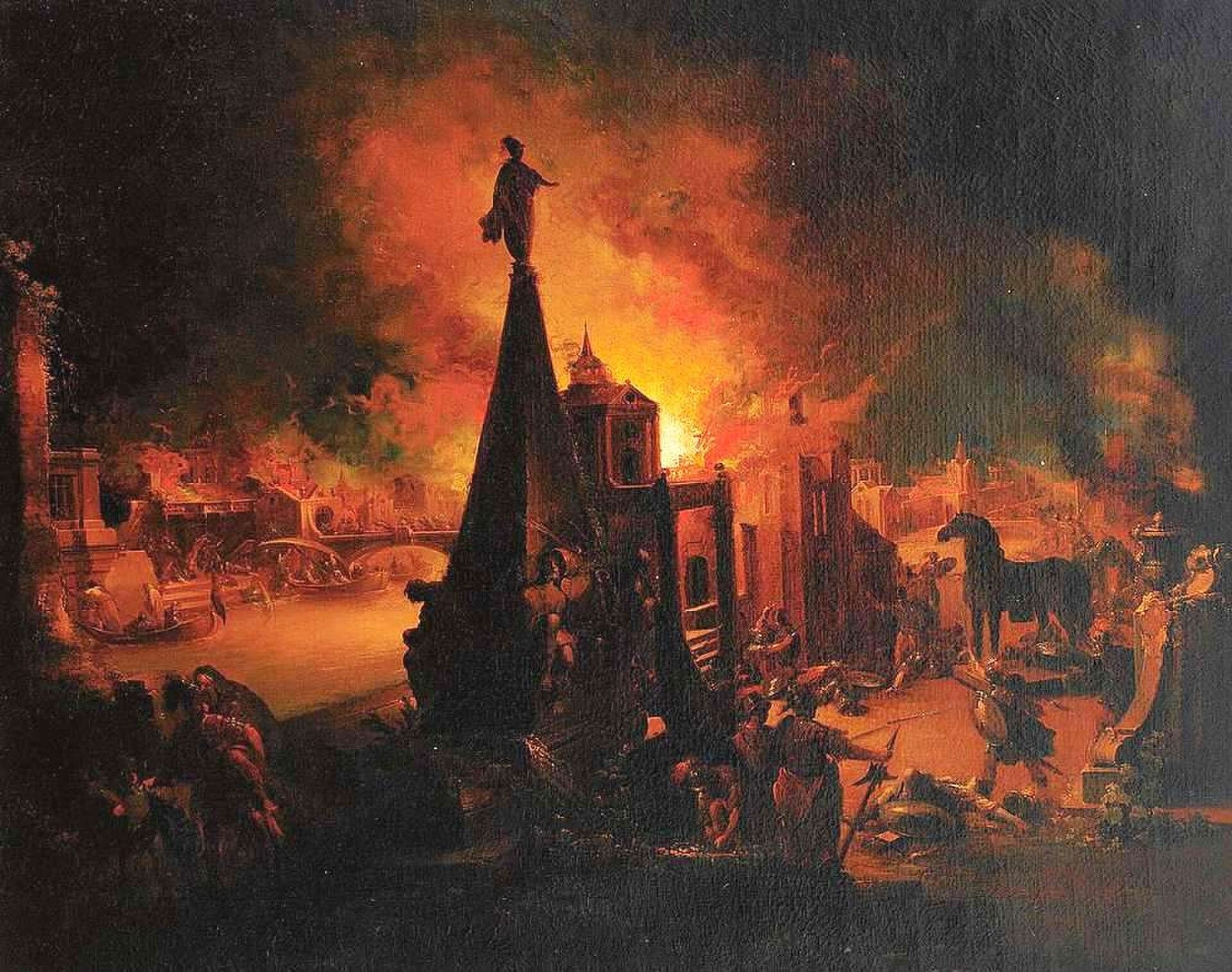
AL: The standout sequence, visually and kinetically, is the nighttime sack of Troy, which is also the film’s finest action set piece. Well... I suppose I am spoiling the movie. Though if you aren’t at least vaguely familiar with The Odyssey by now, gods help you.
Some of the CGI has drawn criticism. My brother, a big cinephile who asked me to write this, was not a fan of a certain pig scene. I thought it all looked fantastic. Nolan somehow imbues Ancient Greece with genuine mythic grandeur while still grounding it in the gritty realism that defines almost all of his films, no matter how fantastical the subject matter.
My brother absolutely loved the score. He’s played it for me multiple times. It is unmistakably a Christopher Nolan score: atmospheric, overwhelming when it needs to be, and always serving the film rather than demanding attention for itself. Not once did I think, Wow, this music is incredible, because it never pulled me out of the experience. Instead, it became part of it, and I think that’s one of the greatest compliments you can pay a film score.
JG: A big nod here, too, to Oscar-nominated designer Ellen Mirojnick, who did her share of looking at millennia-old frescoes to design over 5,3000 costumes that could feel as timeless as the story and its setting.
Outfits in this movie aren’t supposed to be fashionable (even though they are), but to heighten the feeling of the world — its texture and weight: linen, bronze… Fishnet. Designs that pop or erode with their characters, draped robes, helmets. We could easily brush past it, but costume design is what helps make this movie so tactile, authentic, and immersive. [AL: A very good point]
AL: Thematically, we spent a great deal of time discussing Nolan’s reinterpretation of Odysseus. Even if I would have liked to see a bit more of Homer’s prideful, snarky rogue, the pivot toward guilt ultimately works.
On the drive down, my friend Aidan, again, not me, and I talked about what art is supposed to do. Whether it’s a painting, a novel, a song, a film, or an epic poem written nearly three thousand years ago, great art exists to evoke emotion. The very best works don’t inspire just one emotion; they inspire many. Nolan’s Odyssey succeeds.
There is exhilarating action, even if it occasionally becomes difficult to track. There are genuinely horrific moments, with the body horror standing out in particular. There are several real laughs, moments that made my blood boil, and scenes of quiet tenderness.
The treatment of poor Eumaeus and Argos was almost unbearable. Thankfully, Corey Hawkins eventually gets exactly what is coming to him.
Maybe it was simply the weight of waiting two decades for this movie, but I found myself choking up more than once. My brother, whose heart I assume turned to stone after watching Clash of the Titans, disagreed.
Poor Argos. The faithful hunting dog of the King of Ithaca, abandoned outside by the wonderfully loathsome Antinous, played with sniveling perfection by the always-excellent Robert Pattinson, waiting years for the return of his master. That scene genuinely brought tears to my eyes.
So did Anne Hathaway. Hathaway, alongside Damon, delivers the film’s finest performance. As my brother observed, “She doesn’t really do anything.” From an action standpoint, he’s right.
But that misses the point entirely. Hathaway perfectly captures a woman who has spent decades suspended between hope and resignation. She is pulled apart by loyalty to her absent husband, relentless pressure to remarry, the responsibility of protecting a son determined to find his father, the burden of maintaining a kingdom, and the quiet grief that twenty years of waiting inflicts upon someone. I genuinely cannot overstate how good Anne Hathaway is here.
She dominates every scene with Tom Holland, who gives a perfectly solid performance himself, and one of the film’s highlights is simply Penelope finally screaming at him after years of bottled-up fear and frustration. Her reunion with her disguised husband is one of the film’s emotional peaks, and another moment that nearly got me.
JG: Hmmm. Well, yes, I also love Anne Hathaway’s performance; she’s impeccable. But I don’t think she was given the room to develop that character. Within Homer’s Odyssey, women don’t just orbit Odysseus, but constantly move his story forward through scheming, subterfuge, seduction, and sheer sensitivity.
There are the goddesses and sorceresses, the nymphs and sirens — and then, there’s Penelope: who outwits and resists suitors for twenty years, holding off the threat of invasion in her home and kingdom, while dear husband Odysseus doesn’t return.
In Nolan’s movie, we only hear about that story through dialogue, Hathaway fuming at us from the screen probably because she had so much more to show. And it’s a pattern… Throughout the movie, women are there, but perching on the sidelines: as the end trophy, the expository tool, an evil witch. Not as fully developed as they could’ve been.
It’s a shame, because literature has spent decades revisiting these characters, even as protagonists in their own right (I’m currently reading Margaret Atwood’s Penelopiad and couldn’t recommend it more). A modern adaptation of The Odyssey had the chance to lean into that conversation, even if just a little. But it doesn’t.
AL: I don’t think it took away from the movie as much as you did. Nolan’s biggest flaw, in my opinion, is his inability to write fully developed female characters, and that is on display here. My disagreement with you is that I think within the context of cutting this into a 2 hour and 53 minute movie, Penelope is given as much screentime as possible, and within that runtime she is shown to be exercising her autonomy as much as she can within the patriarchal world she inhabits.
John Leguizamo also deserves special praise. Long underrated because of some unfortunate movies, he is magnificent as the loyal swineherd Eumaeus, bringing warmth and quiet dignity to a character who could easily have faded into the background.
Matt Damon is excellent and will deservedly find himself in the Oscar conversation. Personally, though, I think Hathaway gives the stronger performance. Damon succeeds because he imbues Odysseus with exhaustion, desperation, and guilt without ever reducing him to a sad sack. Even burdened by everything he has done, this is still a man clever enough, and stubborn enough, to survive.
JG: Let’s also call out Pattinson for his performance. He delivers a great antagonist in Antinous, leader of Penelope’s suitors. Just the right amount of smugness, with that tooth and nasty twinkle in his eye. Quite the range, Rob.
AL: The cast is stacked, though many of them simply don’t have enough to do. Lupita Nyong’o, Charlize Theron, Mia Goth, who is here for reasons I can’t explain, all leave me wanting more from them and more screen time for them. Neither is their fault.
Ironically, the actor who received perhaps the loudest online backlash before release, Elliot Page, ends up delivering one of the film’s most memorable supporting performances as a shade in the Underworld. The character, Sinon, isn’t even in The Odyssey, serving instead as an invention that gives physical form to Odysseus’ guilt while adding another layer to Pattinson’s Antinous. Despite my initial skepticism of the character, not the casting, it works.
The film runs just shy of three hours, yet it never once dragged for me. The packed Providence IMAX audience seemed to agree, greeting the ending with sustained applause. Granted, there was a moment about five minutes in when the projection failed. For a brief second, I thought the audience was about to tear apart the first IMAX employee who walked into the theater in true Greek mythological fashion.
I’d give The Odyssey a 9.2/10. That is the highest score I’ve given a movie I have seen in theaters in a very long time, perhaps ever. Is it perfect? No. Nothing is.
But it lived up to two decades of anticipation, which may be an even harder feat. It is absolutely worth seeing, preferably in IMAX if you can manage it, and I suspect that, like most of Christopher Nolan’s films, it will only improve with every rewatch. What did you think?
JG: I’d rate it 8.7 ★★★★☆. Despite the complexity flaws, Nolan ultimately understands the scale of The Odyssey and how to bring it as a spectacle. If anything, he did something every adaptation should aspire to: he made me want to pick up the book again.
 | A guest post by
|
So, not only do you spoil the whole movie for me (jk), but you watch it in the same damn cinema that I am going to see it in (if seats ever become available), and with someone who has basically the same name (Julie) as the person I am going to watch it with. This is next level vindictiveness on your part and I tip my hat to you sir.