What Remains
This piece of fiction is the start of something big, but it can be read and enjoyed as a standalone.

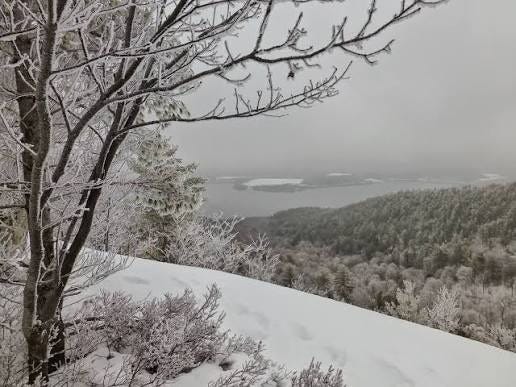
The light briefly broke through the ashen sky. The pale beams looked unnatural, almost foreign, but they still carried a trace of warmth. It touched his face and drew an unexpected smile to his lips.
A memory surfaced. His mother’s warm laughter. His sister’s shrieks of joy. A world that had once been bright and alive. Green. So very green.
The memory was already fading when the sharp crack of a twig shattered it.
He froze.
As quietly as possible, he lowered himself onto one knee in the snow. One hand drifted toward the arrows protruding from the quiver across his back. The other settled near the rusted Glock at his waist, fingers tapping the worn grip.
He forced himself to breathe.
One. Two. Three.
The forest remained still. Then he saw it.
A deer stood among a cluster of barren trees. He watched for several long moments. Its fur was intact. No patches of disease. No visible tumors. It carried a little weight on its frame.
Up here, game was usually healthy. Usually. But caution was the difference between living and dying.
The sun was little more than a memory by the time he finished dressing the carcass and began the long climb back to camp.
He thought it was May. Or perhaps late April. It was difficult to know anymore. The calendar he had scavenged was scarcely reliable anymore.
Entire years had blended together until time felt less like a line and more like a fog. Winters, springs, and summers came and went with little change, and the numbers had lost their meaning.
The forest stretched below him, a patchwork of dead and living things. Bare hardwoods clawed at the darkening sky. Blackened trunks still stood where fires had consumed entire sections of hillsides years ago. Between them, stubborn pines remained, their needles adding the only traces of color to the landscape.
His home sat tucked among rocks near the ridgeline. It was a tangled collection of scavenged lumber, salvaged tarps, animal furs, and dozens of weather-stained bed sheets he had carefully woven through wood and stone to break up its outline. Beneath it all sat an aging tent insulated with blankets, foam, and whatever else he had managed to find.
Inside were shelves of canned food, boxes of stale junk food, bottles of water, tools, books, and stacks of ragged magazines whose pages had yellowed with age.
It was mostly a place to sleep. Over the years, he had built other camps, temporary shelters scattered across the mountains and forests, but this one was different.
This one was as close to a home as he’d had in a very long time.
The view helped. Below him stretched the lake the Mohawks had called Kaniatarakwà:ronte. On a clear day, when the haze wasn’t too thick, he could almost see across it.
He knew the name because of a travel guide he had found years ago in the ruined city on the opposite shore. The book had described Burlington as a bustling college town filled with restaurants, shops, festivals, and tens of thousands of people. More than he had ever seen.
Reading it had felt like reading fantasy. A civilization seemed no more real than the dragons and spaceships in his storybooks.
Now, Burlington was little more than a skeleton of concrete and rust. Burned-out buildings stood like broken teeth along the shoreline, monuments to the desperate battles fought over whatever scraps remained after the collapse.
There wasn’t much left there anymore. But Benny could still find things.
Benny. That was what his sister had called him. He knew it wasn’t his real name. Somewhere, buried beneath the fog, another name belonged to him. But this one had survived. The memory of her voice had survived. No one could take that away from him.
Benny had been alone for almost as long as he could remember.
Almost. The brief thought threatened to pull him somewhere he did not want to go. With practiced ease, he shoved it aside, just as he shoved aside the tarps that served as the door to his home.
Cold air followed him inside. He shrugged out of his ratty winter jacket and hung it from a nail long ago hammered into one of the beams that now held up his collection of tarps, furs, and sheets.
He’d stolen it from a dead man years ago. Not one he’d killed.
The body had been frozen beneath an overpass, half-buried in snow. Benny had been younger then, still thin enough that the sleeves hung past his hands. The man certainly hadn’t needed it anymore.
It had been one of the best finds of his life. The jacket had once been camouflage. Real camouflage. The kind soldiers or hunters wore before the world ended. Now it was mostly shades of brown and gray, stained by dirt, smoke, dried mud, and years of hard use. Several patches had been sewn on with mismatched thread scavenged from sewing kits. One sleeve had been repaired so many times that more of it was patch than original fabric. None of it was helped by the fact that Benny did not truly know how to sew.
Still, it kept the wind out. That was what mattered. Like most of the things he owned, it had survived longer than it was ever meant to. Sometimes Benny wondered if that was true of him, too.
Night settled over the mountains. A small fire crackled inside a ring of stones. Thin strips of venison hissed above the flames, filling the cold air with the smell of roasting meat. He ate slowly, the wind whispering through the pines.
The world was dead. But his stomach was full. The fire was warm. And for tonight, at least, life was almost alright.
There was no sun the next day. Heavy clouds rolled eastward overhead, turning the sky into a ceiling of blueish gray. A light drizzle fell through the trees, tapping softly against the rocks around his camp. Benny stood at the entrance to his shelter and watched it for a moment.
The darkness wasn’t natural. He couldn’t explain why he knew that. He simply did. His mother had explained it once, years and years ago, back when explanations still mattered. Something about ash. Smoke. Dust thrown into the sky. He remembered her voice.
Then the memory slipped away before he could grab hold of it. The familiar ache settled in his chest.
Benny frowned and forced himself to move. Dwelling on memories never helped. The dead stayed dead whether he missed them or not.
He stepped into the drizzle and began setting out rain buckets.
For a long time, he had avoided rain whenever possible. His mother had warned him to. Whatever had destroyed the world had risen into the sky afterward, spreading across it like a wound. Even now, all these years later, something lingered up there. The clouds looked wrong. The winters lasted too long. The summers were never warm enough.
Maybe the rain carried some of it. Maybe it didn’t. He wasn’t sure anymore. Most things he wasn’t sure about.
He’d spent years collecting books whenever he found them. Science books. Textbooks. Encyclopedias. Anything that looked useful.
His reading had improved. His understanding hadn’t always kept pace. Half a year of kindergarten could only carry a person so far.
Physics might as well have been another language. Biology wasn’t much better. Some books explained atoms, radiation, weather patterns, ecosystems, and a thousand other things he couldn’t quite fit together in his head.
He understood survival better than science. How to skin a deer. How to avoid hypothermia. How to spot another human before they spotted him. Those lessons had kept him alive.
Still, he liked reading. Not about science. About people. People fascinated him.
A few years earlier, after discovering the hill where he’d eventually build his camp, he’d ventured into the small town to the south.
Like every town he’d ever visited, it had been dead. Broken windows. Collapsed roofs. Burned houses. Abandoned cars rusting where they’d stopped decades ago. Bones. Always bones.
Yet the books described something completely different. Crowded streets. Families. Schools. Neighbors. Entire communities of people living side by side without trying to kill each other. That was the part he struggled to understand.
In the largest building in town, three connected structures with faded letters that still spelled out something like Willsboro Central School, he had found a collection of history textbooks.
The cafeteria had already been picked clean. He found only empty vegetable cans, rat droppings, and a few dead rodents that had probably been there for years.
The books had been more valuable. He’d spent months reading them.
The textbooks called this place the United States of America. Benny often wondered if it still was. The land was still here. But the bombs had ended that country. What came afterward had finished the job.
One chapter described slavery. Men owning other men. For a long time Benny couldn’t understand it. The books said it was complicated: economics, politics, states’ rights, and dozens of other things.
Benny thought the answer was simpler: Money.
Everything in the old world seemed to come back to money. The magazines he found were filled with advertisements trying to convince people to get things they didn’t need. The newspapers talked about money. Politicians argued about money. Businesses chased money. Wars were fought over money.
The Civil War, the textbooks said, had been fought over slavery and states’ rights. Maybe.
But slaves made their owners money. So to Benny it seemed obvious. People had been willing to kill one another because someone was threatening their money.
Thousands. Hundreds of thousands. Dead over pieces of paper everyone had agreed were valuable. The thought still amazed him. Then again, maybe it shouldn’t have.
People were brutal. Life had taught him that too. Just last year he’d watched a man kill another in the ruins of Burlington.
The fight had lasted less than a minute. Afterward, the survivor had searched the corpse and found a single unopened can. One can. The knife protruding from the dead man’s chest had left a trail of blood down broken pavement. One life traded for one meal.
That made more sense to Benny than any war he’d read about. At least hunger was real.
As easy as it was to forget other people existed, he knew they were out there.
A few had probably always been here. That thought unsettled him. Anyone who survived the years after the bombs had fought for their life.
Everyone had. The skeletons filling the towns, cities, and streets proved that. The ruins proved it. Survival demanded violence.
The only difference was how much. This area had been better than most. The bombs had missed it. Not untouched, nowhere had been untouched, but spared.
The forests had returned. The streams ran clean. Fish still swam in the lake. Deer moved through the valleys. Moose wandered the woods. Wolves roamed everywhere. So many wolves.
The land had healed faster than people had. That was why he stayed. And because there were fewer humans.
When he was younger, they had been everywhere. Hollow-eyed. Diseased. Tumorous. Starving. Bloated from hunger. Desperate enough to do anything.
The books talked about war. They talked about politics, military strategy, and nuclear deterrence. None of them mentioned fathers killing fathers over a loaf of bread. None of them mentioned mothers fighting over stagnant water. None of them mentioned children disappearing.
The old world had fought wars for freedom. For democracy. For nations. For ideals. The new world fought to stay alive.
Yet despite everything, Benny couldn’t quite convince himself people were evil. He thought of his mother.
The memory appeared suddenly: “I love you, Ben. More than you could ever know.”
The words hit him harder than the cold. He rarely thought of himself as Benny anymore. The name really only existed when he remembered her or his sister.
Most days he was simply himself. A pair of hands. A stomach. A body trying to survive. When nobody speaks your name for long enough, you begin to lose it.
He couldn’t remember the last conversation he’d had. A conversation. Years, certainly. Maybe longer.
Before witnessing the killing in Burlington, the last person he’d seen had been months earlier. A distant figure filling water containers beside a stream. He had watched through binoculars. The stranger had never known he was there. That was usually how it happened.
People saw each other. Then one of them died. The lesson had been reinforced four years ago when he first arrived in the area.
Searching for shelter, he’d discovered the remains of a burned house. Little remained above ground. The roof had long ago collapsed inward, and blackened timbers lay scattered across the snow like broken ribs. But the basement was mostly intact.
Inside, hidden beneath several deceptively light beams, he found a trapdoor. Fear twisted in his stomach.
Every instinct told him to leave. Places like this were dangerous. If supplies remained, there was usually a reason. Instead, he opened it.
A ladder descended into darkness. Benny hesitated before switching on his flashlight. Batteries were precious. Curiosity won anyway.
The beam cut through the darkness. Shelves. Boxes. Cans. Books. A few bottles of water. Enough supplies to survive for months. And no sign of people.
Relief flooded him. For a moment, he even found himself silently thanking the wolves, or whoever had killed the people who’d once lived there.
Then as he swept the flashlight across the room, a shoe moved behind a stack of boxes in the corner. Benny froze.
The movement had been small. Almost nothing.
But he saw it. His hand twitched toward the Glock before he stopped himself.
The leg inside the shoe was tiny. A child.
His pulse hammered in his ears.
For several seconds, no one moved. The flashlight remained fixed on the corner.
As his breathing slowed and the pounding in his ears began to fade, he heard something else.
Breathing. More than one set. Quiet. Controlled. Afraid. Trying not to be heard.
His stomach tightened. There were others down there. Not scavengers passing through.
People. A family, even. Or what remained of one.
He imagined frightened eyes staring back from the darkness beyond the reach of his flashlight. A mother clutching a child. A father gripping a weapon, waiting to see if he would have to fight. Waiting to see if Benny would kill them.
Benny slowly backed toward the ladder. One careful step at a time.
No sudden movements. No words. When he reached the top, he climbed out, lowered the trapdoor, and covered it exactly as he had found it.
Then he left. He never returned.
He’d killed before. He knew he’d probably kill again someday. The world almost guaranteed it.
But that was different. He couldn’t explain why. Only that he knew he couldn’t do it. Not for food. Not for shelter. Maybe not even to survive.
Not then. Hopefully not ever. Though he also knew countless others had once said the same thing.
And plenty of them had done whatever survival demanded in the world that remained.
Benny didn’t move much that day. He didn’t have to.
Rain drizzled from dawn, turning the forest into a gray blur of wet stone, dripping pine needles, and mist from where the falling rain met snow. Water ran in thin streams down the hillside and filled the buckets he had set out that morning. The deer would last another five days if he were careful, especially with the canned food he had stocked away. There was no reason to waste energy.
So he read. People fascinated him. People infuriated him.
The old world seemed impossibly strange. Page after page described lives that felt less real than the novels he found. People obsessed over celebrities, following every detail of their lives. Actors. Singers. Influencers, who appeared famous for reasons Benny couldn’t even determine.
The magazines treated them like kings and queens.
Meanwhile, billions of people had lived ordinary lives. It made no sense to him.
So much had been lost. The old world had possessed wonders beyond anything he could imagine, yet its people seemed determined to spend their time watching one another.
One article led him down another rabbit hole. Artificial Intelligence. AI. He’d encountered the term before.
Benny was too young to remember using computers, but he knew what they were. Machines connected across the world, capable of finding information, sending messages, playing games, buying food, teaching skills. Magic, as far as he was concerned.
AI had apparently been a machine designed to imitate human thought. That astounded him. It also irritated him.
According to the article, the men who built these machines had become unimaginably wealthy. For making something that pretended to be another person.
Benny stared at the page. Then he looked around his shelter. At the patched tent. The salvaged blankets. The rusting cookware. The stacks of scavenged cans.
All gone. Every company. Every billionaire. Every government. Every machine. The entire civilization that had built those miracles now existed only in books and memories.
The thoughts lingered as he fed another branch into the fire. The flames brightened briefly, casting wavering shadows across the walls of his shelter. Benny watched them dance. The movement reminded him of something he’d read about in his magazines. Motion pictures. Movies.
Entire stories had once played across giant screens. People had gathered together just to watch them. He tried to imagine it. Hundreds of strangers sitting side by side. Laughing at the same jokes. Crying at the same stories.
For a moment, he wondered what his own life might have been like if the world hadn’t ended. Would he have gone to school? Had friends? Sat in a dark room watching one of those movies while worrying about things that no longer existed, let alone mattered?
The thought felt strange. Almost painful.
Then his stomach growled, pulling him back to reality.
Benny sighed softly and reached for the venison. He set a strip onto his battered camp stove alongside a can of peas. A little salt, carefully rationed from a decades-old container, improved both.
The meal wasn’t much. But it was warm. And that alone made it better than most meals he’d eaten in his twenty-five or twenty-six years.
He wasn’t entirely sure which. The distinction seemed unimportant.
Outside, rain tapped softly against the tarps and canvas of his shelter. Meltwater dripped steadily from the rocks above, and somewhere below, the wind whispered through the pines.
Benny ate slowly, savoring every bite. When the food was gone, he stretched out inside the tent and pulled a blanket over himself.
The day had been warm. Warm enough to melt snow. Warm enough that the damp air carried the smell of wet earth instead of ice. It left him feeling heavy and tired. He listened to the rain for a while longer.
Then, somewhere between one breath and the next, sleep found him. The dream came as it always did. His mother. Brown hair. Brown eyes. A kind face.
She was kneeling in front of him. Smiling. “We’re going to be alright.”
The words were familiar. His father had been sent away to fight. That much he remembered.
But she was promising she wasn’t going anywhere. Jessica wasn’t going anywhere. Everything was going to be okay.
Then it began to change. The sky darkened. The distant horizon flashed. The explosions came.
His mother’s face disappeared beneath blood. She was screaming. At least she always screamed.
This time, something was different. The sound wasn’t a scream. It was a rhythmic chopping noise.
A deep mechanical thudding.
Whup-whup-whup. Whup-whup-whup.
Benny’s eyes snapped open. For a moment, he lay still, confused. The dream clung to him like a cobweb.
Then he heard it again. Whup-whup-whup.
The sound was real. His heart immediately began to race. The noise stirred something ancient in his memory.
Something buried so deep he couldn’t quite reach it.
Whup-whup-whup.
A low whine accompanied it now. He sat upright.
The sound continued. Not thunder. Not wind. Not wolves.
Not anything natural. For the first time in years, Benny felt genuine fear. Beyond everyday survival.
He grabbed the Glock and crawled out of the tent. Rain drizzled through the scarce fading evening light. Then he looked up. And froze. Against the ash-gray sky, moving above the treetops, was a relic from another time.
A helicopter.
Great writing. You built quite an atmosphere. I liked how you weaved in some historical references that we got to see from Benny’s view, it made me feel the Aidan in the piece
Low key the kind of world I dream of, very few people- lots of wolves. I know you added those for me 🐺🤍